

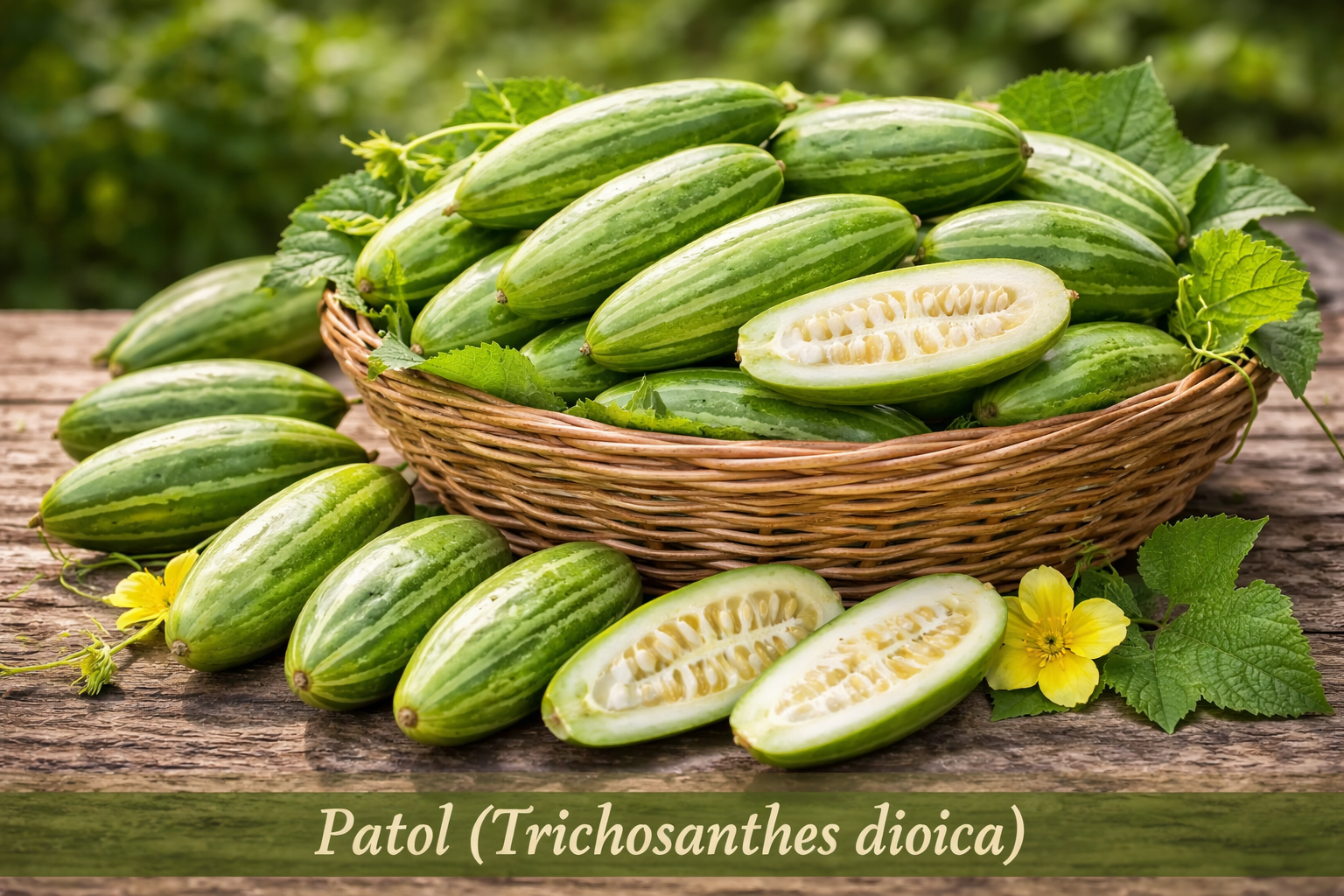
Patol, known botanically as Trichosanthes dioica and commonly referred to as Pointed Gourd or Parwal, is a unique example of a plant that serves simultaneously as a popular vegetable and a revered medicinal herb. While the fruit is a staple in Indian kitchens, particularly in North Indian and Bengali cuisine, the leaf and root of Patol hold significant therapeutic value in Ayurveda. The plant is especially renowned for its action on the skin and its ability to manage fever, making it a key ingredient in several classical formulations.
The plant belongs to the family Cucurbitaceae. It is a dioecious (male and female flowers on separate plants), perennial, climbing herb with a weak stem that requires support. It is extensively cultivated across India, particularly in the Gangetic plains, Uttar Pradesh, Bihar, West Bengal, and Assam. The leaves are simple, alternate, and palmately lobed. The flowers are white. The fruit is the well-known pointed gourd, green with white stripes when immature, turning orange-red when ripe. The part used medicinally is primarily the leaf, though the root also has therapeutic applications.
In Ayurveda, Patol is classified as tikta rasa pradhana (predominantly bitter in taste). It possesses laghu (light) and ruksha (dry) properties and is ushna virya (hot in potency). It is known to balance all three doshas, particularly Pitta and Kapha. Patol is considered a deepana (appetizer), pachana (digestive), and tridoshahara (balancing all three doshas). It is also classified as kushthaghna (effective in skin diseases) and jwara hara (fever-reducing).
The therapeutic applications of Patol are centered primarily on skin disorders and fevers. It is a key ingredient in many classical formulations for kushtha (skin diseases), including eczema, psoriasis, and chronic skin eruptions. Its bitter taste helps in detoxifying the blood and removing ama (toxins) from the system. In fever management, particularly in chronic or recurrent fevers, Patol is highly valued. It is often combined with other bitter herbs like Katuki and Nimba in formulations. Patol is also used in liver disorders, as it supports hepatic function and helps in jaundice. It has mild laxative properties and is used in constipation. The root is sometimes used in snakebite and scorpion sting management in traditional practices.
From a commercial perspective, Patol presents an interesting dynamic. The fruit is a high-volume vegetable crop with an established agricultural supply chain. However, the medicinal raw material—primarily the leaf—is a byproduct of this cultivation. Farmers typically prune the vines to encourage fruit production, and the pruned leaves can be collected and dried for medicinal use. This creates a potential value-added stream from existing agricultural operations. The root is also collected, usually when old plants are removed and replaced. The demand for Patol leaf is driven by manufacturers of skin care formulations, fever management products, and liver tonics. Classical formulations like Patoladi Kvatha and Patoladi Ghrita are well-known and maintain steady demand.
The sourcing of Patol leaf is relatively straightforward but requires coordination with cultivation cycles. The peak availability of leaves coincides with the growing season, typically from spring through early winter. Leaves collected during the pruning process are dried in shade to preserve their green color and active principles. Proper drying is essential to prevent mold and fermentation. The major sourcing regions are the traditional pointed gourd cultivation belts of Uttar Pradesh, Bihar, and West Bengal. Some larger manufacturers may have contract farming arrangements with growers to ensure a consistent supply of quality leaves.
Quality control for Patol leaf involves several parameters. The dried leaves should be green to brownish-green, with the characteristic bitter taste. They should be free from stems, foreign matter, and insect infestation. Macroscopic and microscopic identity should be confirmed. Chemical analysis often focuses on the presence of bitter principles and flavonoids. HPTLC fingerprinting can be used to establish a reference profile and ensure batch-to-batch consistency. Microbial testing is essential, particularly for leaves used in aqueous decoctions (kvatha) where microbial load can concentrate during preparation.
Patol represents the convergence of food and medicine, a concept deeply embedded in Ayurvedic philosophy. Its dual role as a nutritious vegetable and a therapeutic herb makes it accessible and acceptable to a wide population. For the Ayurvedic industry, it offers a raw material that is supported by an existing agricultural infrastructure, making it both sustainable and relatively affordable. As consumer interest in natural skin care and immune-supporting herbs grows, Patol is well-positioned to gain wider recognition and utilization.
