

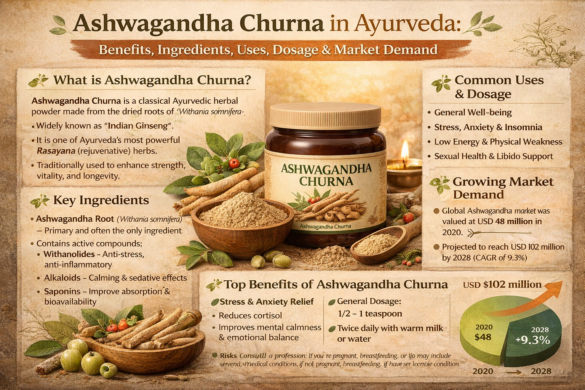
Ashwagandha Churna is a single-herb formulation derived from the root of Withania somnifera, one of the most revered herbs in the Ayurvedic system of medicine. Classified as a “Rasayana” (rejuvenative) and “Balya” (strength-promoting) herb, it has been used for thousands of years to promote vitality, longevity, and overall well-being. The name “Ashwagandha” literally means “smell of horse,” referring to both the odor of the root and the traditional belief that it imparts the strength and vitality of a horse.
Rooted in classical texts like the Charaka Samhita and Sushruta Samhita, Ashwagandha is considered the foremost herb for Vata disorders and is classified as an adaptogen—helping the body cope with physical and mental stress. Today, Ashwagandha has transcended its traditional boundaries to become one of the best-selling herbal supplements globally, with extensive scientific research validating its traditional uses.
Composition and Ingredients
Ashwagandha Churna is a single-ingredient formulation consisting of:
| Ingredient | Sanskrit Name | Botanical Name | Part Used | Primary Function |
| Ashwagandha | Indian Ginseng | Withania somnifera | Root | Adaptogen, rejuvenative, nervine tonic |
The preparation involves careful collection of mature roots, thorough cleaning, drying, and fine powdering. The quality depends significantly on the source, age of the root, and processing methods. The root contains active compounds called withanolides, which are responsible for its therapeutic effects.
Ayurvedic Properties
Ashwagandha is primarily Vata-Kapha pacifying with a mild Pitta-increasing effect due to its heating potency.
| Property | Description |
| Rasa (Taste) | Tikta (Bitter), Kashaya (Astringent), Madhura (Sweet) |
| Guna (Qualities) | Laghu (Light), Snigdha (Unctuous) |
| Virya (Potency) | Ushna (Hot) |
| Vipaka (Post-digestive effect) | Madhura (Sweet) |
| Dosha Effect | Vata-Kapha Shamaka (Pacifies Vata and Kapha) |
It acts as a Rasayana (rejuvenative), Balya (strength promoter), Vajikarana (aphrodisiac), Nadi Balya (nerve tonic), and Medhya (cognitive enhancer). It supports multiple body systems through its adaptogenic, anti-inflammatory, and rejuvenating properties.
Health Benefits
1. Stress and Anxiety Management
Ashwagandha is best known for its adaptogenic properties:
- Reduces cortisol levels (stress hormone)
- Improves resilience to physical and mental stress
- Calms the nervous system
- Reduces anxiety and panic attacks
- Promotes sense of well-being
2. Energy and Stamina
As a Balya herb, it significantly improves:
- Physical energy and endurance
- Muscular strength and recovery
- Athletic performance
- Reduces fatigue and exhaustion
- Supports adrenal function
3. Cognitive Function
Ashwagandha supports brain health by:
- Improving memory and recall
- Enhancing focus and concentration
- Protecting against cognitive decline
- Supporting nerve tissue health
- Reducing brain fog
4. Sexual Health (Vajikarana)
Traditionally used as an aphrodisiac:
- Improves libido in both men and women
- Supports healthy sperm count and motility
- Enhances sexual performance
- Addresses sexual weakness
- Supports reproductive tissue health
5. Male Hormonal Health
Specifically beneficial for men:
- Supports healthy testosterone levels
- Improves sperm quality and quantity
- Addresses male infertility
- Supports prostate health
6. Female Hormonal Health
Beneficial for women’s health:
- Supports hormonal balance
- Helps manage menopausal symptoms
- Reduces stress-related menstrual irregularities
- Supports reproductive health
7. Thyroid Support
Research suggests Ashwagandha:
- Supports healthy thyroid function
- Beneficial in subclinical hypothyroidism
- Balances T3 and T4 levels
8. Immune Modulation
As a Rasayana, it strengthens immunity by:
- Enhancing immune cell activity
- Increasing resistance to infections
- Supporting recovery during illness
- Reducing autoimmune flares
9. Anti-inflammatory Action
The withanolides provide:
- Reduction in inflammatory markers
- Relief from joint pain and stiffness
- Support in inflammatory conditions
- Protection against oxidative stress
10. Sleep Quality
Ashwagandha promotes restful sleep by:
- Reducing cortisol at night
- Calming the nervous system
- Improving sleep depth and quality
- Helpful in insomnia (especially stress-related)
11. Anti-aging (Rasayana)
As a rejuvenative, it:
- Promotes cellular health
- Provides antioxidant protection
- Slows age-related decline
- Supports tissue regeneration
12. Heart Health
Benefits cardiovascular system by:
- Supporting healthy cholesterol levels
- Improving cardiac endurance
- Reducing oxidative stress
- Supporting overall circulation
Usage and Dosage
Standard Dosage
- Adults (Powder): 1/2 to 1 teaspoon (3–5 grams) once or twice daily
- Adults (Capsules): 1–2 capsules (500 mg each) twice daily
- Children: 1/4 to 1/2 teaspoon once daily (under supervision)
- Therapeutic Dosage: Up to 6 grams daily in divided doses under professional supervision
Best Time for Consumption
- With Milk at Bedtime: Classic rejuvenative dosage for sound sleep and tissue nourishment
- Morning with Warm Water: For energy and stress resilience throughout the day
- Before or After Workout: For athletic performance and recovery
- With Meals: For general health and nourishment
Anupama (Adjuvants)
- Milk: The classic adjuvant; enhances nourishing and rejuvenating properties
- Warm Water: For general use and faster absorption
- Ghee: For enhanced bioavailability and Vata disorders
- Honey: For Kapha conditions (in smaller doses)
- Almond Milk: Synergistic nourishing effect
Preparation Methods
- Ashwagandha Milk: Boil powder in milk with a pinch of turmeric and cardamom
- Ashwagandha Decoction: Boil in water until reduced
- Ashwagandha Ghee: Medicated ghee preparation for enhanced benefits
Duration of Use
Can be used for extended periods. For chronic conditions, use in cycles (e.g., 3 months on, 2 weeks off) under professional guidance.
Market and Industry Importance
Ashwagandha Churna has emerged as a blockbuster product in the global herbal supplement industry. It is consistently among the top-selling adaptogenic herbs worldwide.
Market Drivers
- Scientific Validation: Extensive research supporting adaptogenic properties
- Stress Epidemic: Global rise in stress, anxiety, and burnout
- Sports Nutrition: Growing use in athletic and fitness communities
- Cognitive Health: Interest in natural nootropics
- Male Health: Demand for natural testosterone and fertility support
- Aging Population: Need for natural rejuvenatives
- COVID-19 Aftermath: Focus on immunity and stress resilience
