

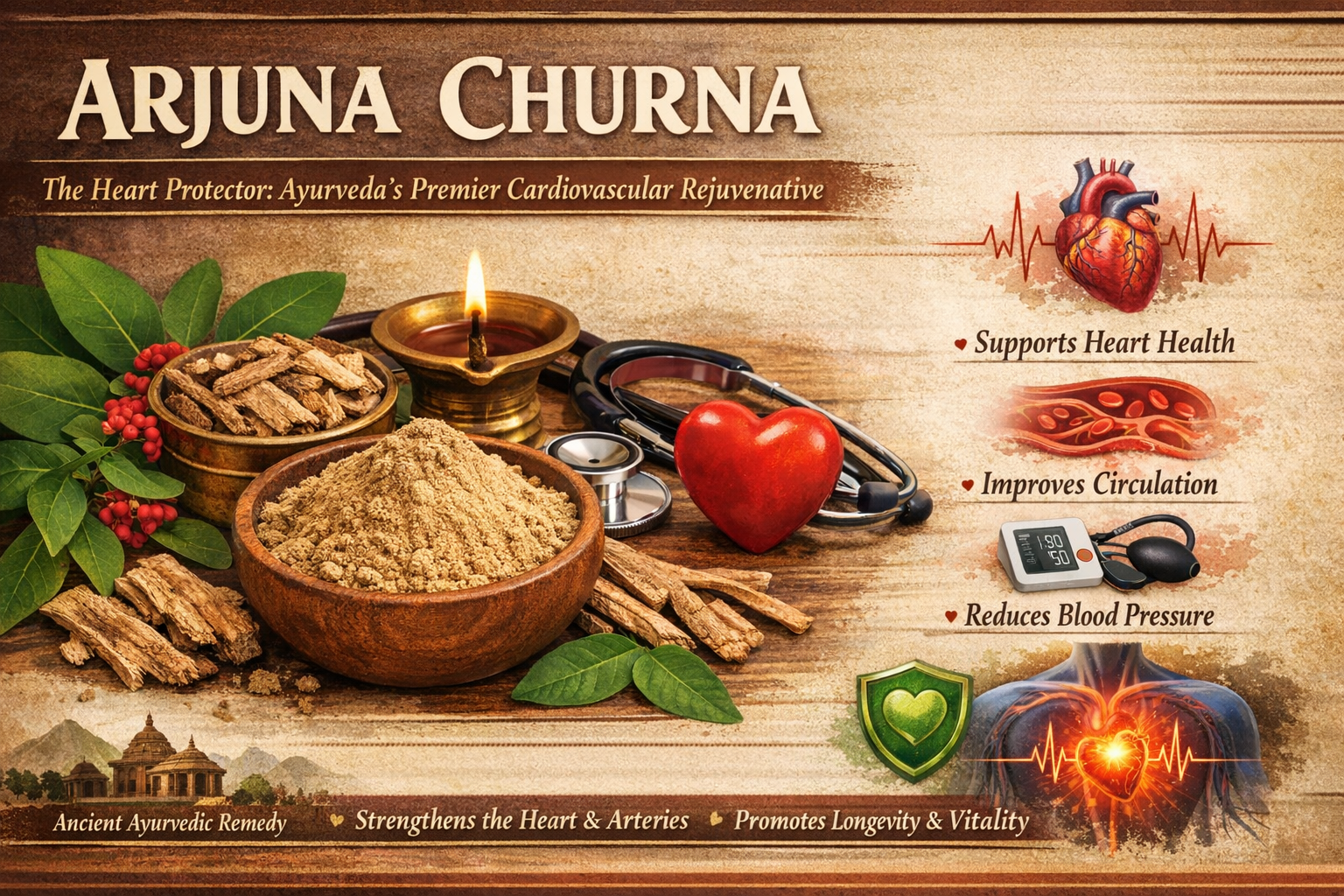
In the vast expanse of Ayurvedic cardiology, one herb stands unrivaled in its affinity for the heart—Arjuna (Terminalia arjuna). Revered for over two millennia as the foremost Hridya (heart-protective) herb, Arjuna has earned its place as the cardiologist’s botanical of choice in traditional Indian medicine. The very name “Arjuna” evokes the legendary warrior of the Mahabharata, suggesting strength, resilience, and unwavering steadiness—qualities that this remarkable herb imparts to the heart it protects.
As cardiovascular disease continues to claim millions of lives annually and the limitations of conventional therapies become increasingly apparent, Arjuna has emerged from the realm of traditional wisdom into the spotlight of evidence-based cardiology. This monograph explores the botanical, clinical, and commercial dimensions of this extraordinary heart tonic.
BOTANICAL IDENTITY
| Scientific Name | Terminalia arjuna (Roxb.) Wight & Arn. |
| Family | Combretaceae |
| Part Used | Stem bark |
| Energetics | Cooling (Shita Virya) |
| Taste | Kashaya (Astringent) |
| Doshic Action | Balances Pitta and Kapha |
THE CLASSICAL LEGACY
Arjuna occupies a position of unparalleled importance in Ayurvedic cardiology. The Charaka Samhita classifies it in the “Hridya” group—herbs specifically indicated for heart health. The Sushruta Samhita recommends it for wound healing and fractures, recognizing its tissue-repairing properties.
| Classical Text | Sanskrit Name | Classification | Key Indications |
| Charaka Samhita | Arjuna | Hridya, Bhagnasandhanakara | Heart disease, fractures |
| Sushruta Samhita | Arjuna | Varnya, Bhagnasandhanakara | Wound healing, complexion |
| Bhavaprakasha | Arjuna | Hridya, Varnya | Heart disease, skin disorders |
PHYTOCHEMISTRY
Modern analysis has revealed over 40 compounds in Arjuna bark, with the primary active constituents being:
| Compound Class | Key Constituents | Primary Activity |
| Triterpenoids | Arjunic acid, Arjunolic acid, Arjungenin | Cardioprotective, antioxidant |
| Flavonoids | Arjunone, Arjunolone | Antioxidant, anti-inflammatory |
| Tannins | Ellagic acid, Gallic acid | Astringent, antioxidant |
| Minerals | Calcium, Magnesium, Zinc, Copper | Cardiac muscle support |
| Co-enzyme Q10 | Ubiquinone | Mitochondrial support |
THERAPEUTIC APPLICATIONS
MYOCARDIAL STRENGTHENING
Arjuna’s primary action is direct myocardial support. Clinical studies demonstrate:
- Increased left ventricular ejection fraction
- Improved cardiac output
- Enhanced exercise tolerance in heart failure patients
- Reduced dyspnea and fatigue
A landmark study published in the Indian Heart Journal showed significant improvement in patients with congestive heart failure after 2 weeks of Arjuna therapy.
ANTI-ISCHEMIC EFFECTS
Arjuna demonstrates remarkable cardioprotection in ischemic conditions:
- Reduces frequency and severity of anginal attacks
- Improves ischemic threshold during exercise
- Decreases need for sublingual nitroglycerin
- Enhances collateral circulation
LIPID MANAGEMENT
Multiple clinical trials confirm Arjuna’s lipid-modifying effects:
- Reduces total cholesterol (15-20%)
- Lowers LDL cholesterol (20-25%)
- Increases HDL cholesterol (10-15%)
- Reduces triglyceride levels
HYPERTENSION MANAGEMENT
Arjuna exerts gentle, sustained hypotensive effects:
- Reduces systolic and diastolic blood pressure
- Improves endothelial function
- Reduces peripheral vascular resistance
- No reflex tachycardia
ANTIOXIDANT PROTECTION
The high tannin and flavonoid content provides:
- Powerful free radical scavenging
- Protection against lipid peroxidation
- Preservation of myocardial integrity
- Reduced oxidative stress markers
ANTICOAGULANT EFFECTS
Arjuna demonstrates mild antiplatelet activity:
- Reduces platelet aggregation
- Improves fibrinolytic activity
- Reduces blood viscosity
- Lowers risk of thrombotic events
HEART FAILURE SUPPORT
In congestive heart failure, Arjuna provides:
- Improved NYHA functional class
- Reduced hospitalizations
- Better quality of life scores
- Enhanced exercise capacity
CLINICAL EVIDENCE SUMMARY
| Condition | Study Design | Outcome | Reference |
| Chronic stable angina | RCT, double-blind | 50% reduction in anginal episodes | Bharani et al., 2002 |
| Congestive heart failure | Open clinical trial | Improved LVEF from 25% to 32% | Dwivedi et al., 2007 |
| Hyperlipidemia | RCT | 22% reduction in LDL cholesterol | Gupta et al., 2001 |
| Hypertension | Clinical trial | 10-15 mmHg reduction in SBP | Maulik et al., 2012 |
FORMULATIONS AND DOSAGE
STANDARD PREPARATIONS
| Formulation | Description | Typical Dosage |
| Arjuna Churna | Fine bark powder | 3-6 grams twice daily |
| Arjuna Capsules | Standardized extract | 500-1000 mg twice daily |
| Arjuna Kwatha | Decoction | 20-30 ml twice daily |
| Arjuna Ksheerapaka | Milk decoction | 50-100 ml twice daily |
OPTIMAL ADMINISTRATION
Anupama (Adjuvants):
- Milk: The classic adjuvant; enhances cardiac nourishment
- Honey: For enhanced absorption
- Warm Water: For general use
Best Time for Consumption:
- Morning and evening with milk
- Empty stomach for maximum absorption
- Before meals for lipid management
SAFETY PROFILE
PRECAUTIONS
| Condition | Recommendation |
| Pregnancy | Avoid; safety not established |
| Lactation | Consult physician |
| Bleeding disorders | Monitor; mild antiplatelet effect |
| Scheduled surgery | Discontinue 2 weeks prior |
DRUG INTERACTIONS
May interact with:
- Antihypertensive medications (additive effect)
- Anticoagulants/Antiplatelets (additive effect)
- Antidiabetic drugs (may enhance effect)
- Thyroid medications (monitor)
ADVERSE EFFECTS
Generally well-tolerated. Rare effects:
- Mild gastric discomfort
- Headache (rare)
- Insomnia (at high doses)
MARKET ANALYSIS
GLOBAL MARKET POSITION
Arjuna has emerged as a leading botanical in the cardiovascular supplement market:
| Region | Market Characteristics | Growth Drivers |
| India | Traditional staple, mass market | High CVD prevalence |
| North America | Premium supplement | Natural cardiology trend |
| Europe | Growing acceptance | Evidence-based medicine |
| Japan | Emerging market | Aging population |
MARKET SEGMENTATION
By Product Type:
- Traditional Churna
- Standardized Capsules
- Liquid Extracts
- Combination Formulations
By Consumer Segment:
- Cardiac patients
- Preventive health consumers
- Aging population
- Fitness enthusiasts
MARKET TRENDS
- Rising cardiovascular disease globally
- Shift toward natural preventive care
- Aging demographic driving demand
- Scientific validation increasing credibility
- Integration into functional foods
SUSTAINABILITY CONSIDERATIONS
The growing demand for Arjuna bark raises important sustainability questions:
Conservation Status:
- Not currently endangered
- Harvesting pressure increasing
- Wild populations declining in some regions
Sustainable Solutions:
- Commercial cultivation programs
- Scientific harvesting methods (partial bark removal)
- Replanting initiatives
- Certification programs
CLINICAL SUMMARY
| Parameter | Recommendation |
| Primary Indications | Angina, heart failure, hyperlipidemia, hypertension |
| Secondary Indications | Post-MI recovery, cardiomyopathy, endothelial dysfunction |
| Standard Dosage | 3-6 grams powder or 500-1000 mg extract twice daily |
| Duration | Long-term, under supervision |
| Key Contraindications | Pregnancy, bleeding disorders |
| Monitoring | BP, lipid profile, cardiac function |
CONCLUSION
Arjuna Churna represents Ayurveda’s most significant contribution to cardiovascular medicine. Its comprehensive range of cardioprotective actions—from inotropic support to lipid management, from antioxidant protection to anti-ischemic effects—makes it a truly remarkable botanical. As modern cardiology increasingly recognizes the limitations of single-target therapies, Arjuna’s multi-modal approach offers a compelling alternative or adjunct to conventional treatment.
For the Ayurvedic industry, Arjuna represents both a responsibility and an opportunity—to ensure sustainable, ethical sourcing while bringing this gift of nature to a world desperately seeking heart health. In an age of cardiac epidemics, the Heart Protector’s wisdom has never been more relevant.
