

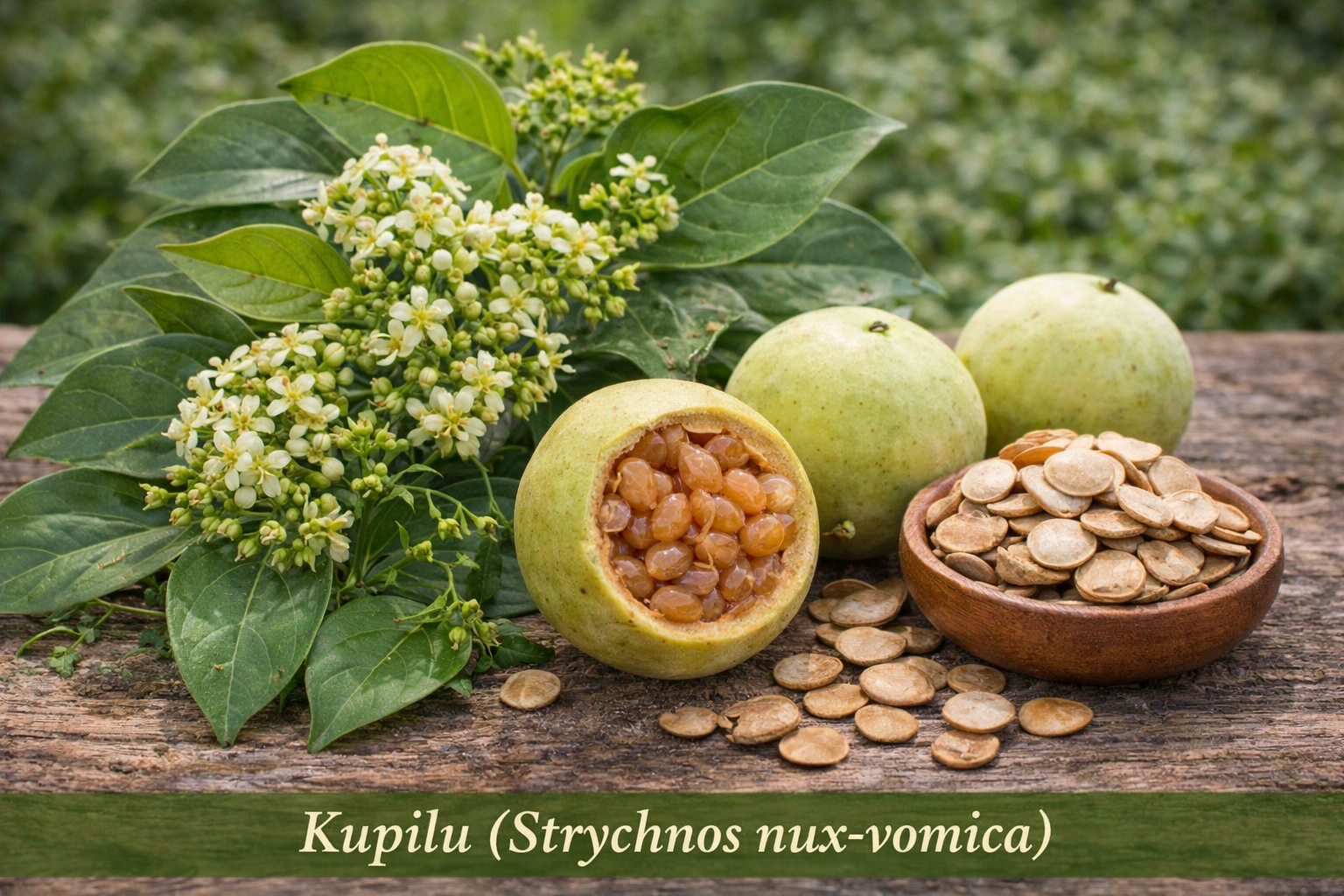
Kupilu, known botanically as Strychnos nux-vomica and commonly referred to as Nux Vomica or Poison Nut, stands as one of the most scientifically intriguing and therapeutically powerful herbs in the Ayurvedic pharmacopoeia. It is a medium-sized deciduous tree native to Southeast Asia, including India, where it grows abundantly in regions like the Western Ghats, Tamil Nadu, Andhra Pradesh, and parts of Odisha. The seeds of this tree contain some of the most well-known alkaloids in pharmacology: strychnine and brucine.
In its raw form, Kupilu is a potent poison. A small quantity of the unprocessed seed can cause severe toxicity, leading to muscle spasms, convulsions, and even respiratory failure. Yet, in Ayurveda, it is classified as an upavisha (semi-poisonous) drug that, after undergoing meticulous shodhana (purification), transforms into a valuable medicine. This dual nature makes Kupilu a subject of fascination and a critical ingredient in several classical formulations used for neurological disorders, digestive ailments, and as a nervine stimulant.
This article provides a comprehensive overview of Kupilu, covering its botanical characteristics, the toxic principles that demand respect, the mandatory purification methods that make it safe, its therapeutic applications, market dynamics, and essential quality considerations for anyone involved in its trade or manufacture.
Botanical Identity and Physical Description
Strychnos nux-vomica belongs to the family Loganiaceae. It is a medium-sized tree, reaching heights of up to 25 meters, with a short, thick trunk and a dense crown. The tree is found extensively in the deciduous forests of central and southern India.
The commercially utilized part is the seed. The fruit of the tree is a smooth, orange-sized berry, orange-red when ripe, containing a white, pulpy flesh surrounding several seeds. The seeds are the “nux vomica” of commerce. They are:
- Appearance: Flattened, disc-shaped, about 2-3 cm in diameter.
- Color: Grayish to greenish-gray, with a silky, shiny surface covered in short, radiating hairs.
- Texture: Very hard and horny.
- Taste: Extremely bitter.
The seeds are the repository of the tree’s potent alkaloids. The white pulp of the fruit, interestingly, is said to be edible and is consumed by some birds and animals, who then disperse the undigested seeds.
The Kupilu Paradox: From Poison to Medicine
The reputation of Kupilu rests entirely on its alkaloid content, primarily strychnine and brucine. These compounds are among the most powerful known stimulants of the central nervous system.
- Strychnine: Acts by blocking the inhibitory neurotransmitter glycine in the spinal cord, leading to uncontrolled muscle contractions and convulsions. In toxic doses, it causes a characteristic “sawhorse” spasm where the body arches backwards.
- Brucine: Similar to strychnine but less potent, it also contributes to the toxic and therapeutic profile.
In its raw, unprocessed state, the seed contains these alkaloids in their full, unmodified form, making it highly dangerous. The therapeutic window—the difference between an effective dose and a toxic one—is extremely narrow.
However, Ayurveda, through centuries of observation and experimentation, developed shodhana protocols to modify the nature of these alkaloids. The purification process does not simply remove the toxins; it transforms them. The processed Kupilu retains its stimulant and therapeutic properties but in a form that is manageable and safe when administered in classical dosages. The key actions of properly processed Kupilu include:
- Nervine stimulant: It is used in conditions of nervous debility, paralysis, and neurasthenia.
- Digestive and carminative: In small doses, it stimulates the digestive tract and is used in atonic dyspepsia and constipation.
- Anti-diarrheal: Classical texts mention its use in chronic diarrhea and dysentery.
- Aphrodisiac and rejuvenative: It is sometimes included in formulations aimed at improving vitality and strength.
Mandatory Purification: Shodhana of Kupilu
For any manufacturer or practitioner working with Kupilu, the shodhana process is the single most critical step. There is no scope for error or shortcuts. The Ayurvedic Formulary of India and classical texts provide detailed, unambiguous methods.
The most common and authoritative method involves processing the seeds in a liquid medium, typically for a specific duration and with specific steps:
- Selection of raw seeds: Mature, sound seeds are selected. They are soaked in a specific liquid.
- Primary soaking: The raw seeds are immersed in a container filled with a liquid medium. Cow’s urine (go-mutra) is the most classically recommended medium for Kupilu shodhana. The seeds are left to soak for a period, often described as seven days.
- Replacement of medium: Each day, for the duration of the soaking period, the old liquid is discarded and replaced with fresh cow’s urine. This ensures continuous contact with fresh, active media.
- Testing for completion: At the end of the soaking period, the seeds are taken out and washed thoroughly with hot water. A key test is performed: the outer skin (testa) of the seed should be easily removable. This indicates that the medium has penetrated and modified the seed’s structure.
- Removal of testa: The softened outer skin is manually removed and discarded.
- Drying and powdering: The de-skinned seeds are dried thoroughly and then powdered. This powder is the processed Kupilu used in formulations.
- Alternative media: In some textual references, other media like cow’s milk or kanji (sour gruel) are also mentioned, but cow’s urine is the most prevalent and accepted standard.
The mechanism of shodhana is believed to involve the hydrolysis or chemical modification of the alkaloids, reducing their acute toxicity while preserving or even enhancing their therapeutic effects. For the quality control department, the proof of proper shodhana lies not just in chemical analysis, but in documented adherence to this classical process.
Therapeutic Applications
Processed Kupilu is a potent ingredient in several classical Ayurvedic formulations. Its use is typically reserved for specific, chronic conditions where its powerful stimulant action is required.
- Neurological Disorders (Vatavyadhi): Kupilu is a primary herb in the management of conditions arising from vitiated Vata dosha. This includes paralysis, hemiplegia, facial palsy, and sciatica. The classical formulation Vatari Churna or Vatari Guggulu often contains Kupilu as a key ingredient.
- Digestive Disorders: In conditions of agni mandya (weak digestive fire) leading to atonic constipation and indigestion, small quantities of processed Kupilu act as a powerful stimulant.
- Chronic Diarrhea and Dysentery (Grahani): Formulations like Kupilu Pak are mentioned in texts for managing chronic digestive disorders.
- Nervous Debility: As a nervine tonic, it is used in cases of general debility, weakness, and loss of nerve function.
- Agni Deepana (Enhancing Digestive Fire): Its stimulant properties are harnessed to kindle the digestive fire in conditions of severe lethargy and sluggish metabolism.
The use of Kupilu is always under the supervision of a qualified Ayurvedic physician, and formulations are prepared with precise dosages.
Market Intelligence: Sourcing, Processing, and Pricing
The market for Kupilu is well-established due to its consistent demand in classical medicine manufacturing.
- Geographical Sourcing: The primary collection areas for wild Strychnos nux-vomica are the forests of the Western Ghats (Karnataka, Kerala, Tamil Nadu), Andhra Pradesh, and parts of Odisha and Madhya Pradesh. The seeds are collected from the forest floor after the fruits ripen and fall.
- Raw Material (Unprocessed) Availability: Unprocessed Kupilu seeds are readily available in major herbal markets. They are typically sold in gunny bags.
- Processed Material: Most major Ayurvedic manufacturers perform shodhana in-house to maintain strict quality control. However, some specialized suppliers also offer processed Kupilu powder. The reliability of such suppliers depends entirely on the rigor of their shodhana process.
- Wholesale Price Range (2025 Estimate):
- Raw, unprocessed seeds: Approximately ₹100 to ₹250 per kilogram.
- Processed Kupilu powder: Approximately ₹400 to ₹800 per kilogram.
- Major Trading Hubs: The largest wholesale market is Khari Baoli in Delhi. Other significant hubs include Indore, Mumbai, and Chennai.
Quality Control Parameters for Procurement
Working with Kupilu requires a robust quality assurance protocol.
For Raw, Unprocessed Seeds:
- Identity: Must be confirmed as Strychnos nux-vomica. They should be sound, mature, and free from insect damage.
- Foreign Matter: Not more than 2%.
- Moisture Content: Should be low (<10%) to prevent fungal growth during storage.
- Alkaloid Content: Raw seeds typically contain 2-3% total alkaloids, of which strychnine constitutes about half. This can be verified by HPLC.
For Processed Kupilu:
- Process Verification: This is the most critical step. The supplier must provide a detailed Standard Operating Procedure (SOP) of their shodhana method. This should include the media used (cow’s urine), duration of soaking (with evidence of daily changes), and post-processing steps. A certificate of analysis alone is insufficient without this process documentation.
- Organoleptic Evaluation: Processed Kupilu powder should not have the extreme bitterness of the raw seed. It should be a fine, uniform powder free from foreign matter.
- Chemical Fingerprinting: HPTLC or HPLC can be used to compare the alkaloid profile of the processed material with a reference standard of properly shodhita Kupilu. While some residual alkaloids remain, the profile should be distinct from the raw seed.
- Microbial and Aflatoxin Testing: Essential for any oral consumption product.
Regulatory and Safety Considerations
Kupilu is subject to strict regulatory oversight.
- Schedule E1: It is explicitly listed in Schedule E1 of the Drugs and Cosmetics Act, which enumerates poisonous substances under the Ayurvedic, Siddha, and Unani systems. Manufacturers must maintain strict records of procurement, processing, and utilization.
- Labeling Requirements: Any formulation containing Kupilu must carry appropriate warnings and clear dosage instructions as per the licensed product literature.
- Manufacturing License Conditions: The license to manufacture Ayurvedic medicines imposes specific conditions regarding the handling of Schedule E1 drugs. The manufacturing premises must have adequate facilities for the safe processing and storage of such materials.
Sourcing Strategy for Manufacturers
For companies incorporating Kupilu into their product range, the following approach is recommended:
- Prioritize In-House Processing: Given the critical nature of shodhana, performing it in-house is the safest and most reliable approach. It requires investment in trained staff, dedicated processing areas, and strict adherence to classical texts, but it provides complete control over the process.
- If Purchasing Processed Material, Audit Thoroughly: If sourcing processed Kupilu from a supplier, conduct a comprehensive audit of their facility. Verify their shodhana process in person. Request samples of their raw material, in-process material, and final product for your own testing.
- Never Compromise on Price: The cheapest processed Kupilu is almost certainly inadequately processed. The cost savings are negligible compared to the potential risk to patient safety and the manufacturer’s reputation.
- Maintain Detailed Batch Records: For every batch of Kupilu used, maintain complete documentation, including the source of raw seeds, the shodhana batch record, and the results of all quality control tests. This documentation is essential for regulatory compliance and traceability.
Key Takeaways
- Botanical Name: Strychnos nux-vomica
- Family: Loganiaceae
- Part Used: Seed, after mandatory purification (shodhana)
- Major Alkaloids: Strychnine and Brucine
- Toxic Effect: Potent central nervous system stimulant, causing convulsions
- Mandatory Pre-Processing: Shodhana by soaking in cow’s urine for a specified period (typically 7 days, with daily changes)
- Primary Therapeutic Uses: Nervous debility, paralysis, atonic dyspepsia, chronic diarrhea
- Raw Material Price (Unprocessed): ₹100 – ₹250 per kg
- Processed Powder Price: ₹400 – ₹800 per kg
- Regulatory Status: Listed in Schedule E1 (Poisonous substance)
- Critical QC Step: Verification of the shodhana process, not just chemical analysis
