

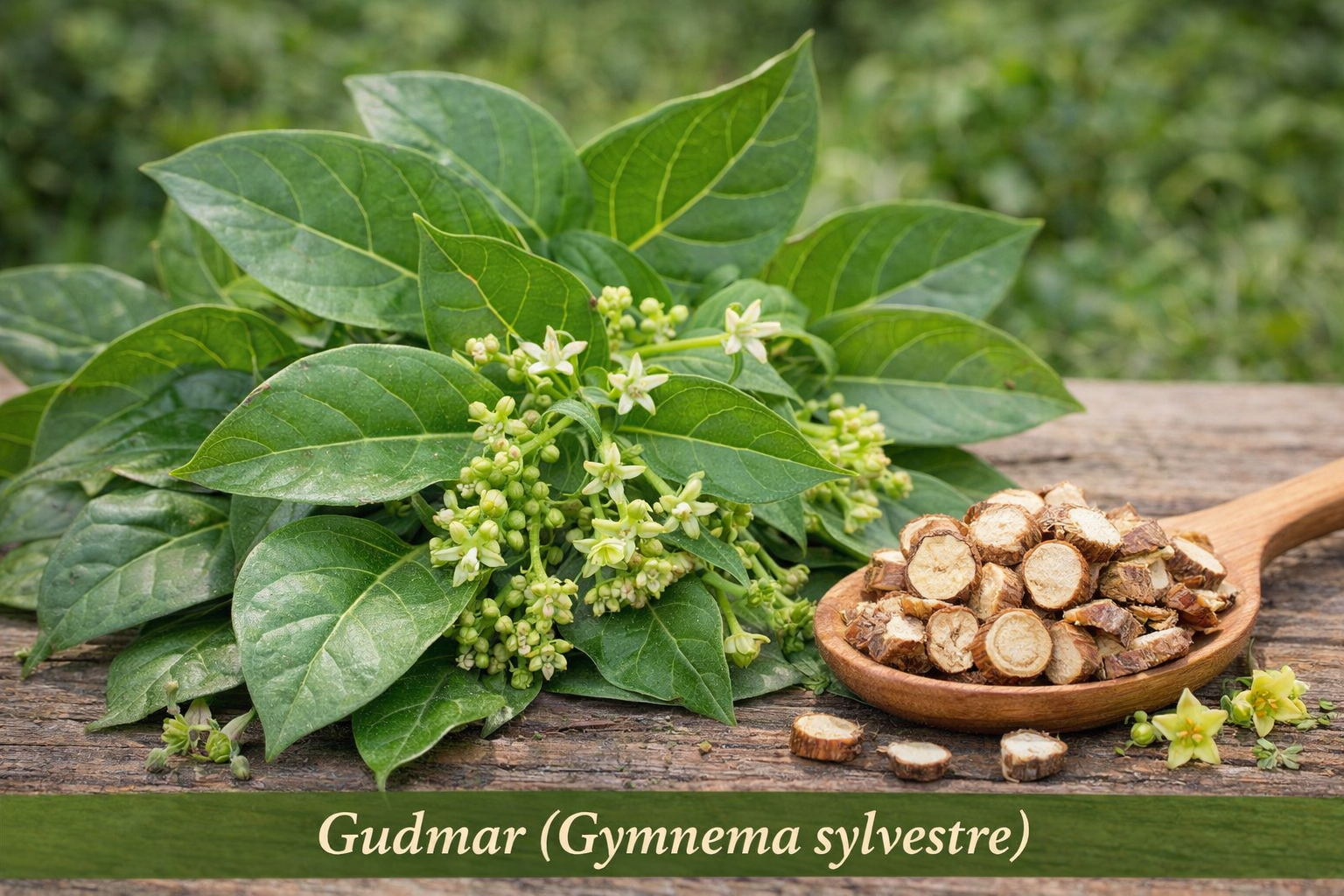
Gudmar, known botanically as Gymnema sylvestre and commonly referred to as Gurmar or “Sugar Destroyer,” stands as one of the most scientifically validated and commercially significant herbs in the entire Ayurvedic pharmacopoeia. Its Hindi name, Gurmar, literally translates to “sugar destroyer,” a direct reference to its extraordinary property of temporarily abolishing the taste of sweetness when the leaves are chewed. This unique and easily demonstrable action hints at its deeper and more important therapeutic application: the management of diabetes and blood sugar disorders. In today’s global nutraceutical and phytopharmaceutical markets, Gudmar has emerged as a star ingredient, with demand extending far beyond India’s borders and into the health food stores and supplement aisles of North America, Europe, and Southeast Asia. For the Ayurvedic manufacturer, exporter, or formulator, understanding the complete profile of this herb is essential for capitalizing on its immense potential.
The plant belongs to the family Apocynaceae, subfamily Asclepiadoideae, placing it among the milkweeds. It is a large, woody, perennial climber that is native to the tropical and subtropical forests of central and southern India. Its natural distribution extends across the Western Ghats, parts of Madhya Pradesh, Chhattisgarh, Jharkhand, and into the Deccan peninsula. It is also found in parts of Africa and Southeast Asia, but the Indian variety is considered the most potent and is the most sought-after in international trade. The leaves are the commercially utilized part of the plant. They are simple, opposite, and typically elliptic or ovate in shape, measuring 3 to 6 centimeters in length. A key identifying feature is the fine pubescence (soft hairs) covering both surfaces, particularly on young leaves, which gives them a slightly velvety texture. As the leaves mature, they may become smoother. The flowers are small and yellow, arranged in umbellate cymes, but it is the leaf that holds all the commercial and therapeutic value.
In the classical Ayurvedic texts, Gudmar is classified with precision. Its taste, or rasa, is described as katu (pungent) and tikta (bitter). Its potency, or virya, is ushna (hot), and its post-digestive effect, or vipaka, is katu (pungent). It is known to balance Kapha and Vata doshas effectively. Functionally, it is considered a deepana (appetizer), a pachana (digestive), and a mutrala (diuretic). However, its most important classification is as pramehahara, meaning it is a primary herb for treating prameha, the Ayurvedic diagnostic category that encompasses diabetes and other metabolic urinary disorders. The property that gives it the folk name “Gurmar” is its ability to temporarily block sweet taste receptors on the tongue, a phenomenon that has intrigued traditional healers for centuries and modern scientists for decades. A person chewing the leaves will find that sugar tastes like sand or tasteless grit for a period of time afterward.
The therapeutic applications of Gudmar are overwhelmingly dominated by its role in blood sugar management, but its utility extends beyond this single indication. The leaves contain a complex mixture of bioactive compounds, most notably a group of triterpene saponins known collectively as gymnemic acids. These gymnemic acids are the molecules responsible for both the taste-suppressing effect and the anti-diabetic activity. Modern pharmacological research has elucidated several mechanisms by which these compounds exert their effects. First, they appear to delay the absorption of glucose from the intestine by occupying sugar receptor sites on the intestinal lining. Second, they may stimulate the secretion of insulin from the beta cells of the pancreas. Third, and most excitingly, some studies suggest that gymnemic acids may promote the actual regeneration or repair of these insulin-producing beta cells, offering a disease-modifying potential rather than just symptomatic relief. Beyond its primary use in diabetes, Gudmar is also employed in managing obesity and hyperlipidemia (high cholesterol), as a digestive stimulant to kindle the digestive fire, and occasionally in formulations for cough and asthma due to its anti-inflammatory properties.
From a commercial and market perspective, Gudmar occupies a position of high value and strategic importance. The global rise in the incidence of type 2 diabetes and metabolic syndrome has created a massive and still-growing market for natural, safe, and effective blood sugar management ingredients. Gudmar extracts, standardized to a specific percentage of gymnemic acids (typically 25%, 50%, or 75%), are featured in countless dietary supplements across the United States, Europe, and Japan. Indian manufacturers and exporters are in a prime position to supply both the raw herb in cut-and-sifted or powdered form, as well as these higher-value standardized extracts, to this international market. The domestic demand within India is equally strong, with Gudmar featuring in numerous Ayurvedic diabetes formulations, both classical preparations like Madhumehari Guggulu and a vast array of proprietary patent medicines.
The sourcing of Gudmar presents a complex picture of opportunity intertwined with sustainability challenges. Historically, and even today, a significant portion of the Gudmar entering the supply chain is collected from the wild. Primary collection areas are the forested regions of Madhya Pradesh, Chhattisgarh, Jharkhand, and the Western Ghats of Karnataka, Kerala, and Tamil Nadu. This wild collection provides a vital source of livelihood for many tribal and forest-dwelling communities. However, the relentless and often unscientific harvesting of leaves, and in some cases the uprooting of entire plants, has led to a documented decline in wild populations in several traditional collection areas. This has raised serious concerns about the long-term sustainability of a supply chain reliant on wild harvest. In response to this challenge and the growing demand, cultivation of Gudmar is gradually increasing. Farmers in states like Madhya Pradesh, Uttar Pradesh, and West Bengal are being encouraged to take up Gudmar as a cash crop, often as part of medicinal plant cultivation programs supported by the National Medicinal Plants Board (NMPB) and various state agencies. Cultivated material offers significant advantages, including full traceability from farm to factory, greater consistency in quality and gymnemic acid content, and a supply that is not subject to the seasonal and geographical vagaries of wild collection.
The price of Gudmar in the wholesale market is not a fixed figure but is influenced by several dynamic factors. The most significant of these is the gymnemic acid content of the material. High-quality leaves, whether from cultivated sources or carefully selected wild collections, that test above 5% gymnemic acids command a premium price. The primary market hubs for raw Gudmar leaves include Khari Baoli in Delhi, as well as regional mandis in Indore, Mumbai, and Chennai. Processors and extract manufacturers typically bypass these spot markets for their bulk requirements, instead sourcing larger quantities directly from established collection agents, farmer cooperatives, or through long-term contracts with dedicated traders who can assure quality and consistent supply. The demand for material accompanied by a certificate of analysis verifying gymnemic acid content is growing rapidly, as buyers seek the raw material consistency required for producing standardized finished products.
Quality control for Gudmar is a multi-layered process that begins with proper identification and extends through sophisticated chemical analysis. The Ayurvedic Pharmacopoeia of India (API) lays down specific standards for the herb, including macroscopic and microscopic identity, permissible limits for foreign matter, total ash, acid-insoluble ash, and extractive values in alcohol and water. Microscopic examination of the leaf powder reveals characteristic features such as covering trichomes (multicellular, uniseriate hairs with warty walls), anomocytic stomata, and cluster crystals of calcium oxalate. However, the critical test for commercial purposes is the quantification of gymnemic acids. High-Performance Thin Layer Chromatography (HPTLC) and High-Performance Liquid Chromatography (HPLC) are the standard analytical techniques used to generate a chemical fingerprint and accurately measure the concentration of these active compounds. For suppliers targeting the export market, additional testing for pesticide residues, heavy metals (lead, cadmium, arsenic, mercury), and aflatoxins (B1, B2, G1, G2) is mandatory to comply with the regulatory requirements of importing countries like the United States, those in the European Union, and Japan.
In conclusion, Gudmar’s journey from a traditional remedy for diabetes, known in every village, to a globally recognized and scientifically validated nutraceutical ingredient is a powerful example of the potential inherent in the Ayurvedic herb trade. Its strong scientific backing, clear mechanism of action, and well-defined chemical markers make it a relatively easy herb to integrate into modern product development pipelines. For the Ayurvedic industry as a whole, ensuring a sustainable and ethical supply of high-quality Gudmar through the promotion of cultivation and responsible wild collection practices is a critical priority for the coming decade. For the individual manufacturer or exporter, a deep understanding of the supply chain, a commitment to rigorous quality control, and access to material with verified gymnemic acid content are not just advantages but essential requirements for success in the competitive global market for natural health products.
