

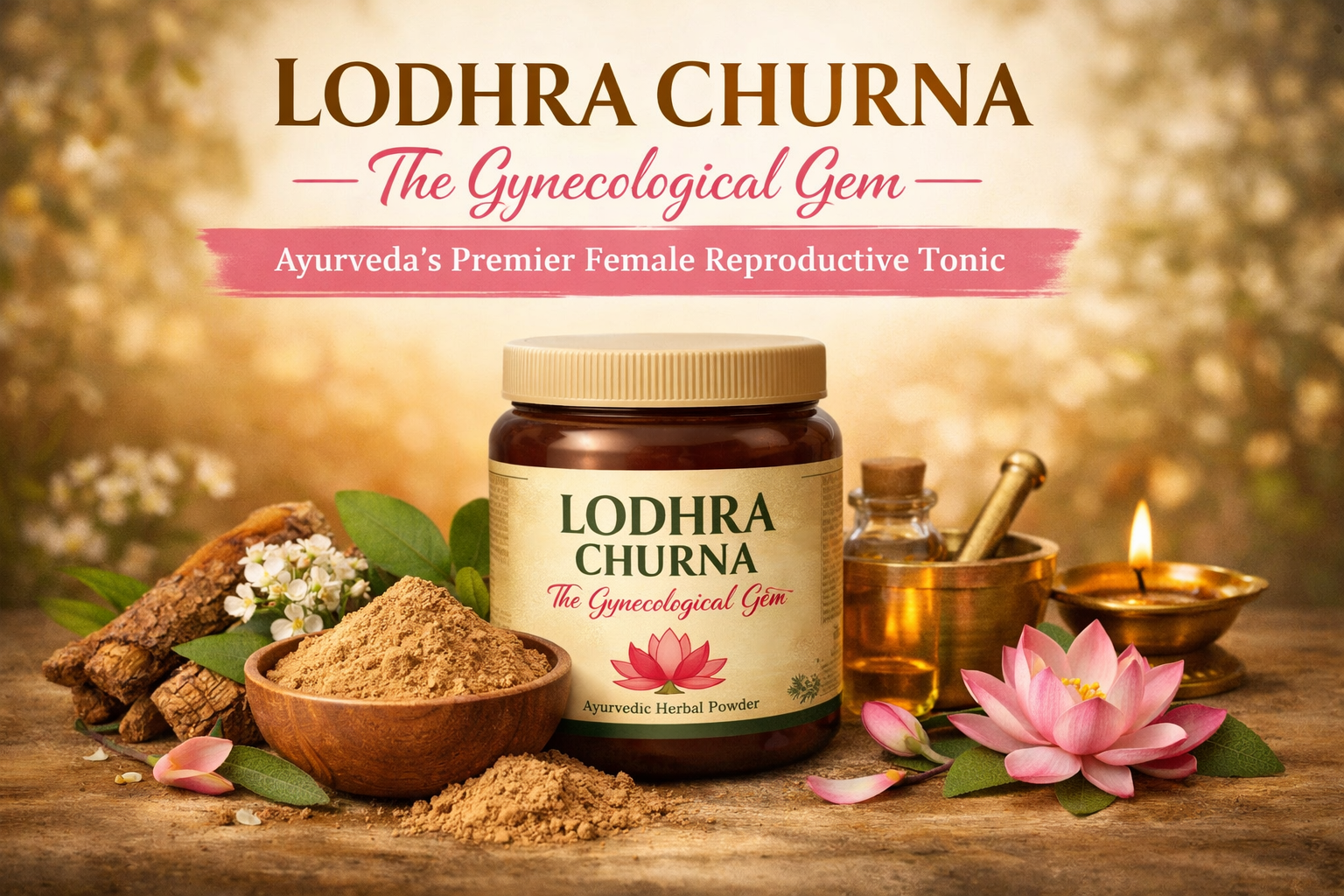
The Gynecological Gem: Ayurveda’s Premier Female Reproductive Tonic
Lodhra (Symplocos racemosa) occupies a specialized yet indispensable position in the Ayurvedic pharmacopoeia. Revered primarily for its affinity with the female reproductive system, this remarkable herb has been used for centuries to address a wide range of gynecological disorders. Its very name evokes its primary action—”Lodhra” is derived from the root “Lodh,” meaning to crush or subdue, referring to its ability to subdue excessive bleeding and inflammation.
While less globally recognized than Ashwagandha or Brahmi, Lodhra remains an essential tool in the Ayurvedic gynecologist’s arsenal, with applications ranging from menstrual disorders to cervicitis, from leucorrhea to postpartum care. This monograph explores the botanical, clinical, and commercial dimensions of this underappreciated gem.
BOTANICAL IDENTITY
| Scientific Name | Symplocos racemosa Roxb. |
| Family | Symplocaceae |
| Part Used | Stem bark |
| Energetics | Cooling (Shita Virya) |
| Taste | Kashaya (Astringent), Tikta (Bitter) |
| Doshic Action | Balances Pitta and Kapha |
THE CLASSICAL LEGACY
Lodhra’s prominence in gynecological texts is unmatched. The Charaka Samhita classifies it in the “Yonidoshahara” group—herbs specifically indicated for female reproductive disorders.
| Classical Text | Sanskrit Name | Classification | Key Indications |
| Charaka Samhita | Lodhra | Yonidoshahara, Grahi | Menorrhagia, leucorrhea |
| Sushruta Samhita | Lodhra | Stambhana, Sandhaniya | Bleeding disorders, wound healing |
| Ashtanga Hridaya | Lodhra | Yonidoshahara | Gynecological disorders |
| Bhavaprakasha | Lodhra | Grahi, Stambhana | Diarrhea, excessive bleeding |
PHYTOCHEMISTRY
| Compound Class | Key Constituents | Primary Activity |
| Alkaloids | Loturine, Colloturine | Anti-inflammatory |
| Tannins | Ellagic acid derivatives | Astringent, hemostatic |
| Flavonoids | Quercetin, Kaempferol | Antioxidant, anti-inflammatory |
| Saponins | Symplocososide | Hormonal modulation |
| Phenolics | Salirepin | Antimicrobial |
THERAPEUTIC APPLICATIONS
MENSTRUAL DISORDERS
Lodhra’s primary claim to fame lies in its remarkable ability to regulate menstrual bleeding:
Menorrhagia (Heavy Bleeding):
- Reduces excessive menstrual flow
- Shortens bleeding duration
- Decreases clotting
- Provides uterine hemostasis
Metrorrhagia (Intermenstrual Bleeding):
- Controls breakthrough bleeding
- Stabilizes endometrial lining
- Reduces spotting
Mechanism: The high tannin content provides astringent and hemostatic effects, while phytosterols may modulate hormonal balance.
LEUCORRHEA (WHITE DISCHARGE)
Lodhra is the herb of choice for abnormal vaginal discharge:
- Reduces quantity of discharge
- Improves discharge quality
- Addresses underlying inflammation
- Provides antimicrobial action
Clinical Application: Often combined with other herbs like Ashoka and Daruharidra for comprehensive management.
CERVICITIS AND CERVICAL EROSION
Local and systemic use benefits cervical health:
- Reduces cervical inflammation
- Promotes healing of erosion
- Decreases cervical discharge
- Supports epithelial health
UTERINE PROLAPSE
In mild uterine prolapse, Lodhra provides supportive therapy:
- Tones uterine supporting tissues
- Reduces associated discomfort
- Decreases bearing-down sensation
POSTPARTUM CARE
Traditional postpartum applications include:
- Uterine involution support
- Lochial regulation
- Prevention of postpartum hemorrhage
- Perineal healing
INFLAMMATORY BOWEL CONDITIONS
Beyond gynecology, Lodhra benefits:
- Diarrhea (especially chronic)
- Dysentery
- Irritable bowel syndrome (IBS-D)
- Intestinal inflammation
SKIN DISORDERS
Classical texts mention Lodhra in:
- Acne and pimples
- Skin inflammation
- Wound healing
- Eczema (topical and internal)
ORAL HEALTH
Used in dental preparations for:
- Gum inflammation
- Bleeding gums
- Mouth ulcers
- Periodontal health
FORMULATIONS AND DOSAGE
TRADITIONAL PREPARATIONS
| Formulation | Description | Typical Dosage |
| Lodhra Churna | Fine bark powder | 3-6 grams twice daily |
| Lodhra Capsules | Standardized powder | 500-1000 mg twice daily |
| Lodhra Kwatha | Decoction | 20-30 ml twice daily |
| Lodhra Lepa | External paste | As required |
| Lodhra Taila | Medicated oil | For local application |
OPTIMAL ADMINISTRATION
Anupama (Adjuvants):
- Honey: For enhanced absorption and gynecological conditions
- Warm Water: For general use
- Buttermilk: For diarrheal conditions
- Ghee: For Pitta disorders
Best Time for Consumption:
- During menstrual phase for bleeding disorders
- After meals for digestive conditions
- Twice daily for chronic gynecological issues
EXTERNAL APPLICATIONS
Vaginal Tampon (Pichu):
Lodhra Churna mixed with honey or ghee on sterile gauze for local cervical application
Douche (Yoni Prakshalana):
Lodhra Kwatha diluted for vaginal wash in leucorrhea
Paste (Lepa):
For external application in skin disorders
CLINICAL APPLICATIONS BY CONDITION
| Condition | Dosage | Duration | Combination |
| Menorrhagia | 3-6 grams twice daily | 3-6 cycles | Ashoka, Nagakeshara |
| Leucorrhea | 3-5 grams twice daily | 4-8 weeks | Daruharidra, Triphala |
| Cervicitis | 3 grams twice daily + local | 4-6 weeks | Yashtimadhu, Guggulu |
| Diarrhea | 2-4 grams three times | 1-2 weeks | Bilva, Musta |
| Skin disorders | 3 grams twice daily + external | 4-8 weeks | Manjishtha, Neem |
SAFETY PROFILE
PRECAUTIONS
| Condition | Recommendation |
| Pregnancy | Avoid in first trimester; use under supervision thereafter |
| Constipation | May worsen due to astringent properties |
| Dry conditions | Use with hydrating adjuvants (milk, ghee) |
DRUG INTERACTIONS
May interact with:
- Anticoagulants (additive effect)
- Iron supplements (tannins may reduce absorption)
- Antidiarrheal medications
ADVERSE EFFECTS
Generally very well-tolerated. Rare effects:
- Mild constipation
- Decreased appetite
- Dry mouth
MARKET ANALYSIS
MARKET POSITION
Lodhra occupies a specialized niche in the women’s health category:
| Region | Market Characteristics | Growth Drivers |
| India | Traditional staple | Gynecological practice |
| Export | Specialty product | Women’s health focus |
| Global | Limited but growing | Natural hormone balance |
MARKET SEGMENTATION
By Product Type:
- Traditional Churna
- Capsules/Tablets
- Liquid Extracts
- Combination Formulas
By Consumer Segment:
- Women with menstrual disorders
- Postpartum women
- Women with recurrent leucorrhea
- Natural health consumers
MARKET TRENDS
- Rising awareness of women’s health issues
- Preference for natural gynecological care
- Increasing diagnosis of PCOS and hormonal disorders
- Postpartum wellness focus
- Integration into fertility protocols
CLINICAL SUMMARY
| Parameter | Recommendation |
| Primary Indications | Menorrhagia, leucorrhea, cervicitis |
| Secondary Indications | Diarrhea, skin disorders, gingivitis |
| Standard Dosage | 3-6 grams powder twice daily |
| Duration | Cyclical (menstrual) or continuous |
| Key Contraindications | Pregnancy (first trimester) |
| Monitoring | Menstrual flow, discharge quality |
CONCLUSION
Lodhra Churna exemplifies Ayurveda’s profound understanding of women’s health—an herb that addresses root causes rather than merely suppressing symptoms. Its remarkable astringent and anti-inflammatory properties, combined with its specific affinity for the female reproductive tract, make it indispensable in managing common yet distressing conditions like menorrhagia and leucorrhea.
For the Ayurvedic industry, Lodhra represents a specialized opportunity—a product with loyal, recurring demand from women seeking natural solutions for intimate health concerns. As the global conversation around women’s health expands, this humble bark from the forests of India is poised to find its place in wellness protocols worldwide.
