

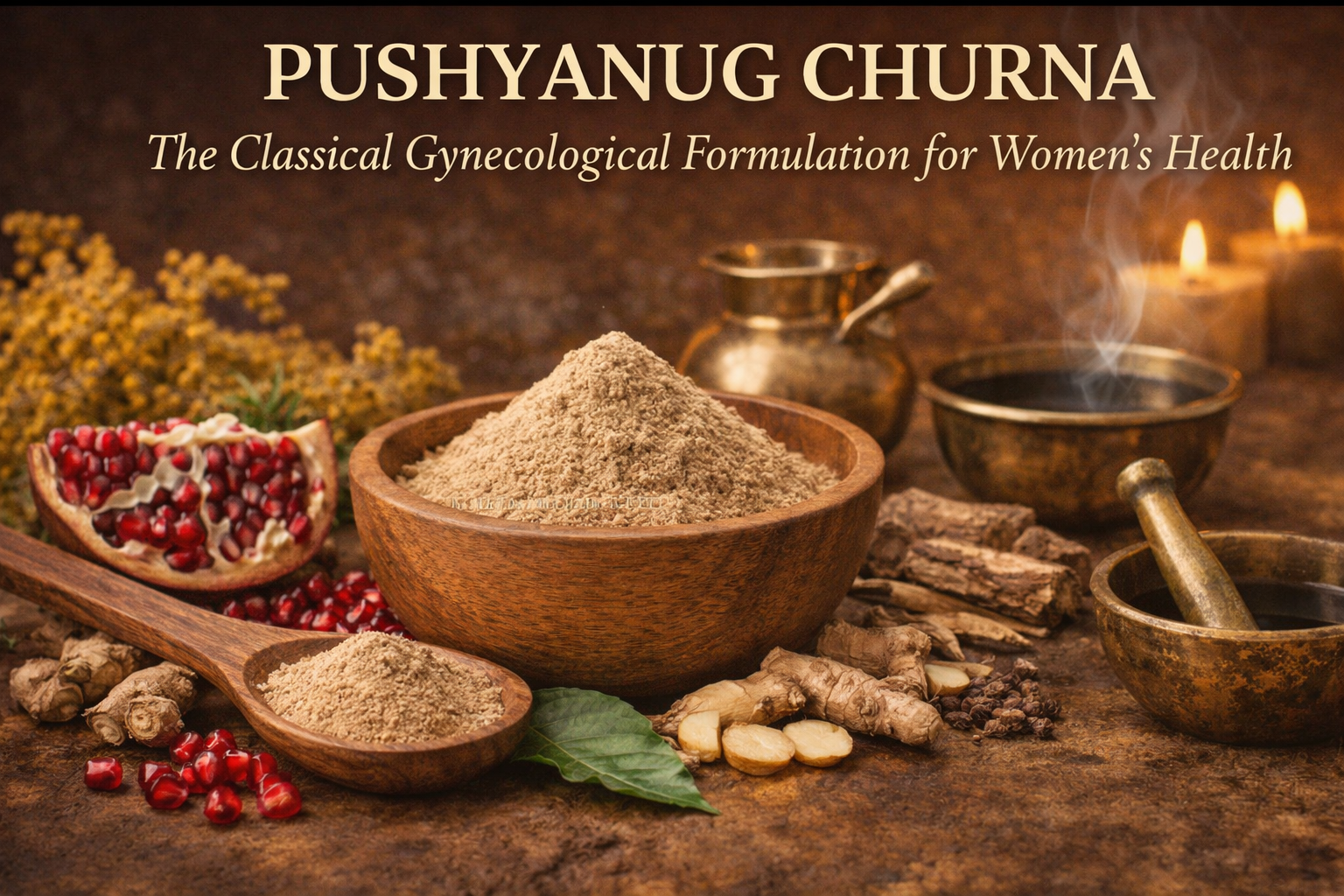
Pushyanug Churna stands as one of the most revered classical formulations in Ayurvedic gynecology. Named after the auspicious Pushya nakshatra (star) under which it is traditionally prepared, this compound formulation addresses a wide spectrum of female reproductive disorders, particularly those involving excessive bleeding and abnormal discharge. Its enduring presence in clinical practice for over a millennium speaks to its remarkable efficacy and safety profile.
This monograph explores the classical origins, therapeutic applications, and contemporary relevance of this comprehensive gynecological formulation.
CLASSICAL ORIGINS
Pushyanug Churna finds its primary reference in the Bhaisajya Ratnavali, specifically in the “Yoni Roga Chikitsa” chapter (gynecological disorders). The name “Pushyanug” derives from two elements:
- Pushya: The auspicious star under which preparation is recommended
- Anug: Following or conforming to
The formulation is also detailed in the Sharngadhara Samhita and Yoga Ratnakara, indicating its widespread acceptance across classical traditions.
COMPOSITION AND INGREDIENTS
Pushyanug Churna is a complex polyherbal formulation containing approximately 20-25 ingredients, with variations across different textual references.
CORE INGREDIENTS
| Ingredient | Sanskrit Name | Botanical Name | Primary Function |
| Lodhra | Symplocos racemosa | Uterine tonic, astringent | |
| Ashoka | Saraca indica | Uterine stimulant, hormonal balance | |
| Daruharidra | Berberis aristata | Anti-inflammatory, antimicrobial | |
| Mocharasa | Salmalia malabarica | Hemostatic, astringent | |
| Nagakeshara | Mesua ferrea | Anti-hemorrhagic, uterine tonic | |
| Dhataki | Woodfordia fruticosa | Wound healing, astringent | |
| Gairika | Red Ochre | Mineral astringent, hemostatic | |
| Chandana | Santalum album | Cooling, anti-inflammatory | |
| Usheera | Vetiveria zizanioides | Cooling, urinary tonic | |
| Musta | Cyperus rotundus | Digestive, anti-inflammatory | |
| Bilva | Aegle marmelos | Digestive, astringent | |
| Kutaja | Holarrhena antidysenterica | Anti-diarrheal, antimicrobial |
Note: Complete formulation includes additional herbs and may vary by tradition.
THERAPEUTIC APPLICATIONS
PRIMARY INDICATIONS
Menorrhagia (Raktapradara):
Pushyanug Churna is the formulation of choice for excessive menstrual bleeding:
- Reduces heavy menstrual flow
- Decreases bleeding duration
- Minimizes clotting
- Addresses underlying uterine pathology
Leucorrhea (Shweta Pradara):
Equally effective for abnormal vaginal discharge:
- Reduces quantity of discharge
- Improves discharge quality
- Addresses associated inflammation
- Provides antimicrobial action
Metrorrhagia:
Controls intermenstrual bleeding through:
- Uterine hemostasis
- Endometrial stabilization
- Hormonal modulation
SECONDARY APPLICATIONS
Cervicitis and Cervical Erosion:
- Reduces cervical inflammation
- Promotes epithelial healing
- Decreases discharge
Postpartum Hemorrhage Prevention:
- Supports uterine involution
- Provides hemostatic support
- Reduces lochial discharge
Pelvic Inflammatory Disease (PID):
- Reduces pelvic inflammation
- Provides antimicrobial action
- Supports tissue healing
Recurrent Abortion (Threatened):
In threatened abortion with bleeding, provides supportive therapy under strict supervision
Diarrhea and Dysentery:
The astringent and antimicrobial properties benefit:
- Acute diarrhea
- Chronic dysentery
- Irritable bowel syndrome (IBS-D)
PHARMACOLOGICAL ACTIONS
| Action | Mechanism | Clinical Benefit |
| Stambhana (Hemostatic) | Tannin-mediated vasoconstriction | Reduced bleeding |
| Grahi (Absorbent) | Intestinal fluid absorption | Controlled diarrhea |
| Pittahara (Cooling) | Inflammatory mediator reduction | Reduced inflammation |
| Kushtaghna (Anti-skin disorder) | Antimicrobial, anti-inflammatory | Clearer skin |
| Yonidoshahara (Gynecological) | Uterine-specific affinity | Reproductive health |
FORMULATIONS AND DOSAGE
STANDARD DOSAGE
| Form | Dosage | Timing | Anupama |
| Churna (Powder) | 3-6 grams twice daily | After meals | Honey, buttermilk, or rice water |
| Tablets/Capsules | 500-1000 mg twice daily | After meals | Warm water |
| Kwatha (Decoction) | 20-30 ml twice daily | After meals | As directed |
DOSAGE BY CONDITION
| Condition | Dosage | Duration | Special Instructions |
| Acute menorrhagia | 5 grams three times daily | 5-7 days | Start with onset of bleeding |
| Chronic menorrhagia | 3-4 grams twice daily | 3-6 cycles | Cyclical use |
| Leucorrhea | 3 grams twice daily | 4-8 weeks | With honey |
| Postpartum | 3 grams twice daily | 4-6 weeks | With milk and ghee |
CLINICAL GUIDELINES
PATIENT SELECTION
Ideal Candidates:
- Women with Pitta-predominant constitution
- Heavy menstrual bleeding without organic pathology
- Chronic leucorrhea
- Postpartum women needing uterine support
Less Ideal Candidates:
- Vata-predominant individuals (may require additional Vata-pacifying herbs)
- Severe constipation (may worsen due to astringent properties)
- Pregnancy (except under specific supervision)
COMBINATION THERAPY
| Condition | Combination | Rationale |
| Severe menorrhagia | Ashokarishta | Synergistic uterine action |
| With anemia | Punarnava Mandura | Iron supplementation |
| With pain | Dashamoola | Vata pacification |
| Chronic leucorrhea | Chandraprabha Vati | Comprehensive metabolic support |
SAFETY PROFILE
CONTRAINDICATIONS
| Condition | Recommendation |
| Pregnancy | Avoid in first trimester; use under supervision thereafter |
| Severe constipation | Use with hydrating adjuvants |
| Acute pelvic infection | Combine with antimicrobial therapy |
| Organic uterine pathology | Investigate before use |
DRUG INTERACTIONS
May interact with:
- Anticoagulant medications (additive effect)
- Iron supplements (tannins may reduce absorption)
- Oral contraceptives (theoretical interaction)
ADVERSE EFFECTS
Generally very well-tolerated. Rare effects:
- Mild constipation
- Decreased appetite
- Dry mouth
- Nausea (if taken on empty stomach)
QUALITY CONSIDERATIONS
| Parameter | Requirement |
| Raw material authenticity | All ingredients botanically verified |
| Manufacturing | GMP certified |
| Microbial purity | Pathogen-free |
| Heavy metals | Within safe limits |
| Aflatoxins | Absent |
MARKET POSITION
TARGET AUDIENCE
- Women with menstrual disorders
- Postpartum women
- Women with chronic leucorrhea
- Ayurvedic practitioners
- Gynecologists integrating Ayurveda
MARKET DIFFERENTIATORS
- Classical authenticity
- Comprehensive action spectrum
- Time-tested safety
- Multiple therapeutic applications
CLINICAL SUMMARY
| Parameter | Recommendation |
| Primary Indications | Menorrhagia, leucorrhea, metrorrhagia |
| Secondary Indications | Cervicitis, postpartum support, diarrhea |
| Standard Dosage | 3-6 grams powder twice daily |
| Optimal Adjuvant | Honey or buttermilk |
| Duration | Cyclical or continuous based on condition |
| Key Contraindications | First trimester pregnancy |
| Monitoring | Menstrual flow, discharge quality |
CONCLUSION
Pushyanug Churna represents the pinnacle of classical Ayurvedic gynecology—a thoughtfully crafted formulation that addresses the root causes of female reproductive disorders while providing symptomatic relief. Its multi-targeted approach, combining hemostatic, anti-inflammatory, antimicrobial, and uterine-tonic actions, makes it uniquely suited for the complex, multifactorial nature of gynecological conditions.
For the Ayurvedic practitioner, Pushyanug Churna remains an indispensable tool. For the pharmaceutical industry, it represents a time-tested product with consistent demand. And for countless women suffering from menstrual and reproductive health issues, it offers hope—a natural, effective solution rooted in thousands of years of clinical wisdom.
