

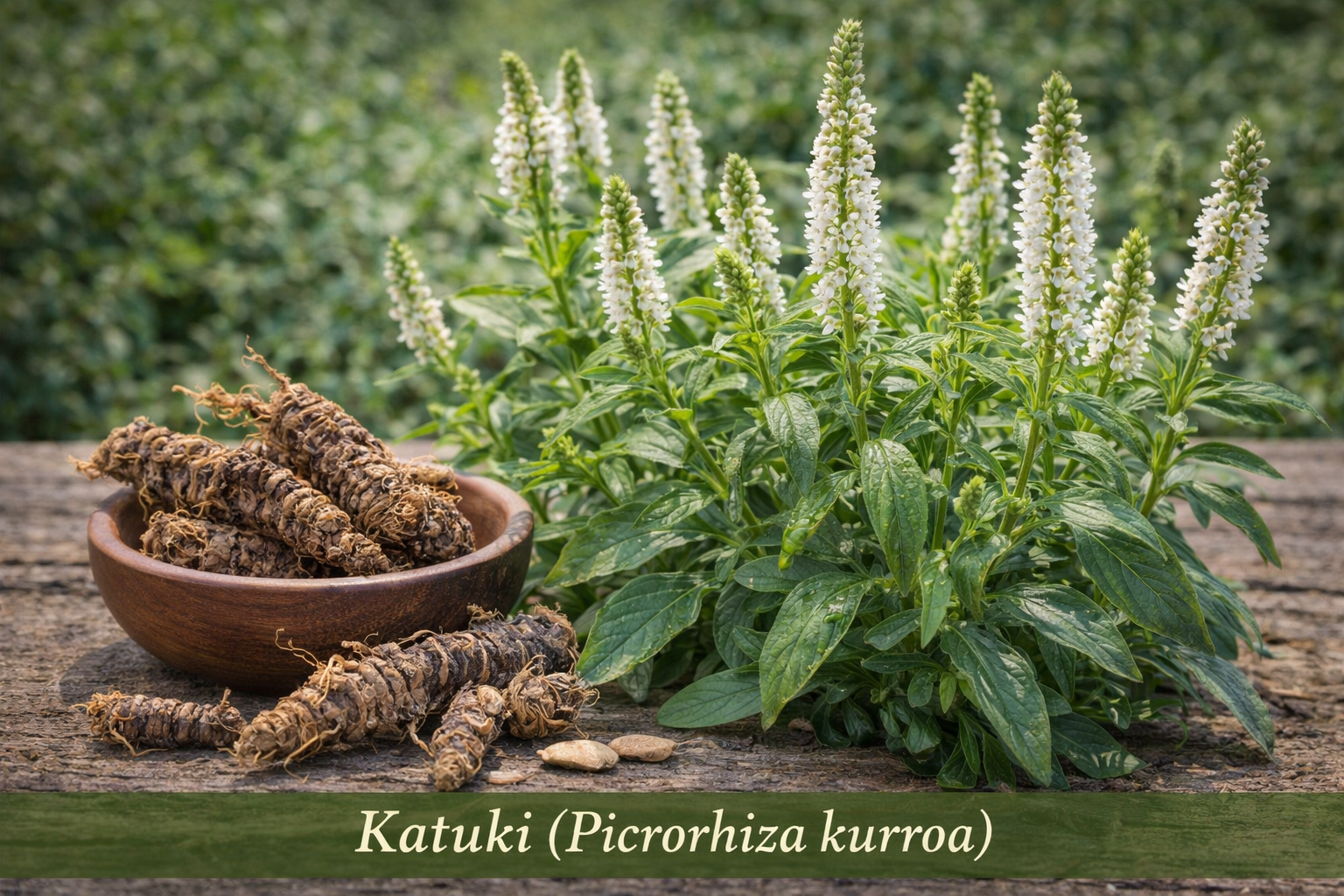
Katuki, known botanically as Picrorhiza kurroa, stands as one of the most commercially valuable and therapeutically significant herbs in the Ayurvedic pharmacopoeia. Often called Kutki or Indian Gentian in trade circles, this small perennial herb from the high altitudes of the Himalayas has earned the nickname “Bitter Gold” for good reason. Its primary application as a hepatoprotective agent places it at the heart of some of Ayurveda’s most trusted formulations, including Arogyavardhini Vati and various proprietary liver care products.
For the B2B reader—whether you are a procurement manager sourcing raw materials, a quality control officer verifying incoming batches, a manufacturer formulating liver care products, or an exporter looking to tap into the global nutraceutical market—Katuki presents a unique set of opportunities and challenges. The demand for authentic, high-potency Katuki has never been higher. Yet simultaneously, the supply of genuine wild-crafted material is shrinking, prices are volatile, and the market is awash with adulterants and substitutes. Understanding the complete lifecycle of this herb, from its alpine habitat to the factory floor, is no longer optional; it is essential for business continuity and regulatory compliance.
This comprehensive guide is designed specifically for industry professionals. It covers the botanical identity of Katuki, the therapeutic drivers behind its demand, the critical conservation issues affecting its supply, the pervasive problem of adulteration, current market intelligence, and actionable sourcing strategies for the years ahead.
Botanical Identity and Preferred Variety
Correct botanical identification is the first and most critical step in sourcing. Picrorhiza kurroa belongs to the family Plantaginaceae (formerly placed in Scrophulariaceae). It is a small, hairy herb with a stout, creeping rhizome that is the commercially utilized part. The plant is native to the alpine Himalayas, thriving at altitudes ranging from 3,000 to 4,500 meters above sea level. Its natural distribution stretches across the Indian Himalayan states of Jammu & Kashmir, Himachal Pradesh, Uttarakhand, and Sikkim, and extends into Nepal and Tibet.
The part used in Ayurvedic medicine is the dried rhizome, often collected along with the roots. The therapeutic potency and commercial value of Katuki are directly linked to its content of bitter iridoid glycosides, primarily Picroside I and Picroside II. These two compounds serve as the key chemical markers for standardization. The Ayurvedic Pharmacopoeia of India (API) specifies minimum requirements for these markers, and any reputable supplier should be able to provide a Certificate of Analysis (CoA) quantifying their presence.
A critical distinction for buyers is the difference between Picrorhiza kurroa and Picrorhiza scrophulariiflora. The latter, often originating from Nepal and Tibet and traded as “Tibetan Kutki,” contains a different profile of picrosides. While it is sometimes used as a substitute, it is not the species authorized in classical Ayurvedic texts. For formulations claiming to adhere to API standards, sourcing genuine P. kurroa is non-negotiable.
Therapeutic Applications Driving Demand
The primary driver of global demand for Katuki is its well-documented hepatoprotective activity. It is considered one of the most effective herbs for supporting liver health, acting as a powerful cholagogue (promoting bile flow) and hepatoprotective (protecting liver cells from damage). This makes it a key ingredient in formulations for:
- Jaundice and Hepatitis: Katuki is a cornerstone herb in managing infective hepatitis and other liver inflammations.
- Liver Cirrhosis and Fatty Liver: With the rising incidence of non-alcoholic fatty liver disease (NAFLD) globally, Katuki-based supplements are gaining immense popularity.
- Fever and Malaria: Classical formulations for intermittent fevers often feature Katuki due to its bitter properties and its effect on liver metabolism.
- Allergies and Skin Disorders: By supporting liver detoxification, Katuki plays a supportive role in managing chronic skin conditions like eczema and psoriasis.
- Digestive Disorders: As a deepana (appetizer) and pachana (digestive), it is used in conditions of weak digestion and ama (toxin) accumulation.
This wide therapeutic window has propelled Katuki beyond the traditional Ayurvedic pharmacy and into the mainstream nutraceutical industry. Export demand from the United States, Europe, and Southeast Asia for “liver detox” and “immune support” supplements has added significant pressure on the already strained raw material supply. For manufacturers, this translates to a consistent and growing requirement for high-quality, standardized Katuki extracts and powders.
Conservation Status and Legal Implications
The high demand and the slow growth of the plant have created a conservation crisis. Picrorhiza kurroa is a slow-growing perennial that takes anywhere from 3 to 7 years to reach a harvestable size. The lucrative prices offered for wild rhizomes have led to indiscriminate uprooting, often before the plants have had a chance to seed and regenerate.
Consequently, Picrorhiza kurroa has been accorded significant protective status:
- IUCN Red List: It is classified as Endangered. Its population in the wild is estimated to have declined by more than 50% over the past few decades.
- CITES Listing: It is included in Appendix II of the Convention on International Trade in Endangered Species of Wild Fauna and Flora (CITES). This means that international trade in the species must be controlled to avoid utilization incompatible with its survival.
For exporters, this is not a trivial matter. Shipping Katuki without valid CITES permits can result in the seizure of consignments, hefty fines, and a ban on future trade. For domestic manufacturers, it signals that reliance solely on wild collections is unsustainable. The legal framework is gradually pushing the industry towards cultivated sources, and forward-thinking companies are already aligning their procurement strategies accordingly.
The Adulteration Problem
Adulteration is perhaps the single biggest quality challenge facing Katuki buyers today. The scarcity and high price of genuine Picrorhiza kurroa create a strong economic incentive for unethical suppliers to mix or substitute inferior materials.
The most common adulterants and substitutes include:
- Picrorhiza scrophulariiflora: As mentioned earlier, this is the most common substitute. It is often sold simply as “Kutki,” and without chemical analysis, it can be difficult to distinguish. However, its picroside profile differs, and it is not compliant with API standards for P. kurroa.
- Andrographis paniculata (Kalmegh): Known as Bhunimba, this herb also has hepatoprotective properties but is a completely different species. It is significantly cheaper and is sometimes used to “cut” pure Katuki.
- Gentiana kurroa (Indian Gentian): Another endangered Himalayan herb, it is occasionally mixed in, further complicating the conservation and quality picture.
- Inert Material and Filler: Stems, leaves, and other non-rhizome parts of the Picrorhiza plant itself are sometimes added to increase bulk and weight.
- Exhausted Material: Material that has already been extracted for its active compounds may be dried and sold again, possessing little to no therapeutic value.
How to Identify Authentic Katuki
Quality control laboratories must employ a combination of techniques:
- Organoleptic Evaluation: Genuine Katuki rhizomes are intensely bitter. A weak or flat taste profile is a red flag. The rhizomes are typically 2-7 cm long, 0.5-1.5 cm thick, cylindrical, and dark brown to greyish-brown externally.
- Microscopy: A transverse section of the rhizome shows a distinct anatomy, including a wide cortex and characteristic starch grains and calcium oxalate crystals.
- Thin Layer Chromatography (TLC): This provides a quick fingerprint profile to compare against a reference standard.
- High-Performance Thin Layer Chromatography (HPTLC) or High-Performance Liquid Chromatography (HPLC): These are the gold standards for quantification. A CoA from a reliable supplier should show clear peaks for Picroside I and II, with concentrations meeting or exceeding API specifications (which typically require not less than 0.5% and 1.0% respectively, depending on the monograph).
Procurement teams should make it a policy to never purchase Katuki sight-unseen or based on price alone. A request for a CoA with every batch should be a mandatory part of the purchase order.
Market Intelligence: Prices, Hubs, and Trends
The price of Katuki is dynamic and influenced by the Himalayan monsoon, the accessibility of collection areas, and the enforcement of collection bans.
- Wholesale Price Range (2025 Estimate): Genuine, good-quality wild-crafted Picrorhiza kurroa rhizomes currently trade in the range of ₹900 to ₹1,600 per kilogram. Prices at the higher end are commanded by material with verified high picroside content, clean cutting, and proper drying. Cultivated material, while still limited in volume, may trade at a slightly different price point.
- Primary Trading Hubs: The major wholesale markets for Katuki are:
- Khari Baoli, Delhi: The largest spice and herb market in Asia, a major clearing house for material from across North India and Nepal.
- Haldwani, Uttarakhand: The gateway to the Kumaon Himalayas, this is a primary collection and aggregation point for wild-harvested herbs.
- Tanakpur and other border towns: These serve as entry points for material coming from Nepal.
- Seasonal Availability: Fresh Katuki usually enters the market after the monsoon, typically from September to November. Prices can firm up during the off-season as stocks dwindle.
Quality Control Parameters
For manufacturers, establishing a robust quality control protocol for Katuki is essential. Key parameters to verify from the Certificate of Analysis include:
| Parameter | Specification / What to Look For |
| Identity | Confirmed by TLC/HPTLC fingerprint matching Picrorhiza kurroa reference. |
| Picroside I Content | As per API, typically not less than 0.5% (may vary by specific pharmacopoeia). |
| Picroside II Content | As per API, typically not less than 1.0% (may vary). |
| Foreign Matter | Not more than 2%. |
| Total Ash | Not more than 7-9%. |
| Acid-Insoluble Ash | Not more than 1-1.5%. |
| Alcohol-Soluble Extractives | Not less than 12-15%. |
| Water-Soluble Extractives | Not less than 18-22%. |
| Microbial Contamination | Should be within limits for total bacterial count, yeast, mold, and absence of pathogens (E. coli, Salmonella, S. aureus). |
| Aflatoxins & Pesticide Residue | Should be within permissible limits, especially for export consignments. |
Sourcing Strategy for 2025 and Beyond
The era of relying entirely on cheap, undocumented wild collections is ending. For companies that depend on Katuki, a proactive sourcing strategy is required.
- Build Traceability: Insist on knowing the origin of your Katuki. Is it from wild collections in a specific Himalayan valley, or from a cultivated plot? Traceability is the first step towards sustainability and risk management.
- Support and Seek Cultivated Sources: Cultivation is the only long-term solution. Several initiatives supported by the National Medicinal Plants Board (NMPB) and state agricultural universities are promoting Katuki farming in high-altitude areas like Lahaul-Spiti in Himachal Pradesh and parts of Uttarakhand. Building direct relationships with farmer producer organizations (FPOs) in these regions can secure a more reliable and ethically sound supply chain.
- Develop Long-Term Partnerships: Avoid spot-buying on the open market. Work with a few select suppliers who demonstrate a commitment to quality and authenticity. Share your quality requirements with them and provide feedback on the material received. A strong supplier relationship is your best defense against adulteration.
- Invest in Testing: If your company’s volume justifies it, consider bringing HPTLC or HPLC testing in-house. If not, partner with a reputable third-party lab for random batch testing to verify your supplier’s CoA.
- Understand Export Compliance: If you are exporting, ensure your supply chain can provide the necessary CITES documentation. This is a non-negotiable legal requirement. Relying on a supplier who cannot provide this puts your entire export business at risk.
Key Takeaways
- Botanical Name: Picrorhiza kurroa
- Family: Plantaginaceae (formerly Scrophulariaceae)
- Part Used: Dried rhizome (with roots)
- Major Chemical Markers: Picroside I and Picroside II
- Conservation Status: Endangered (IUCN), CITES Appendix II
- Primary Sourcing Risk: Adulteration with Picrorhiza scrophulariiflora or other hepatoprotective herbs like Kalmegh
- Recommended QC Method: HPTLC/HPLC for quantification of Picroside I & II
- Current Wholesale Price Indicator: ₹900 – ₹1,600 per kg (depending on quality and picroside content)
- Red Flag for Exporters: Inability of supplier to provide valid CITES permits
