
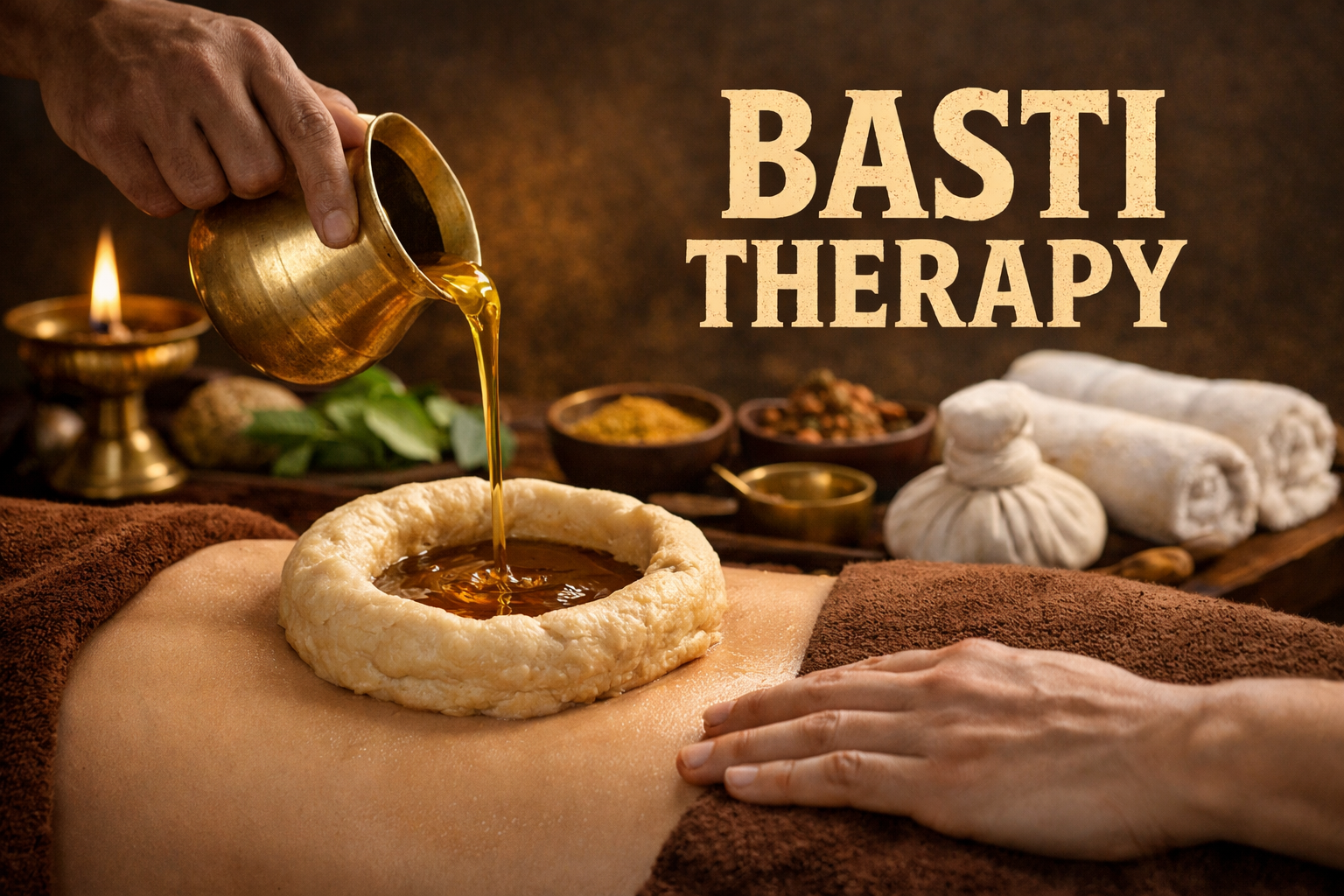
3. BASTI THERAPY
The Most Powerful Panchakarma Treatment: Ayurvedic Enema Therapy
Basti therapy occupies the most exalted position among the five Panchakarma procedures. The Charaka Samhita declares, “There is no better treatment for Vata disorders than Basti—it is half the entire treatment, indeed the complete treatment.” This statement reflects the profound significance of Basti in managing Vata dosha, which is considered the primary force behind most diseases. Basti involves the administration of medicated decoctions, oils, and other substances through the rectal route, systematically addressing Vata at its root.
CLASSICAL SIGNIFICANCE
Basti is described in extraordinary detail in the Charaka Samhita (Siddhi Sthana) and Sushruta Samhita (Chikitsa Sthana). It is classified into numerous types based on the substances used, the method of administration, and the therapeutic indication. The therapy is traditionally performed during the rainy season (Varsha Ritu), when Vata naturally accumulates and is most easily managed.
Classical Quotes:
- “Basti is the best treatment for Vata disorders, just as irrigation is best for thirsty crops.” – Charaka
- “Basti is the half of all treatments, indeed the complete treatment.” – Charaka
- “There is no disease caused by Vata that cannot be cured by Basti.” – Sushruta
TYPES OF BASTI
PRIMARY CLASSIFICATIONS
| Type | Substances Used | Primary Indication |
| Anuvasana Basti | Medicated oil | Vata disorders, lubrication, nourishment |
| Niruha Basti | Medicated decoction | Detoxification, cleansing |
| Yoga Basti | Sequence of 8 Bastis | Comprehensive Vata management |
| Karma Basti | Sequence of 16 Bastis | Chronic Vata disorders |
| Kala Basti | Sequence of 30 Bastis | Severe, chronic conditions |
THERAPEUTIC VARIANTS
| Variant | Key Ingredients | Specific Application |
| Dashamoola Basti | Dashamoola decoction | Neurological disorders, back pain |
| Erandamoola Basti | Castor root decoction | Sciatica, arthritis |
| Vidaryadi Basti | Nourishing herbs | Wasting disorders, weakness |
| Vaitarana Basti | Toxic herbs (processed) | Severe rheumatism, gout |
| Madhutailika Basti | Honey, oil, salt | General detoxification |
THERAPEUTIC PRINCIPLES
MECHANISM OF ACTION
| Level | Action | Effect |
| Local (Colon) | Direct contact with mucosa | Cleanses accumulated toxins, normalizes absorption |
| Regional (Pelvis) | Absorption through rectal veins | Affects reproductive and urinary systems |
| Systemic (Whole body) | Absorption into circulation | Balances Vata throughout body |
| Neural (Nervous system) | Vagus nerve stimulation | Parasympathetic activation, stress reduction |
PHYSIOLOGICAL EFFECTS
- Regulates Apana Vata (downward-moving energy)
- Normalizes bowel function
- Reduces neurological inflammation
- Improves nutrient absorption
- Enhances muscle and joint function
- Balances neurotransmitter activity
INDICATIONS
PRIMARY INDICATIONS – VATA DISORDERS
| System | Condition | Classical Name |
| Neurological | Sciatica | Gridhrasi |
| Facial palsy | Ardita | |
| Hemiplegia | Pakshaghata | |
| Parkinsonism | Kampavata | |
| Musculoskeletal | Arthritis | Sandhigata Vata |
| Back pain | Katishoola | |
| Cervical spondylosis | Manyastambha | |
| Frozen shoulder | Avabahuka | |
| Gastrointestinal | Constipation | Vibandha |
| IBS | Grahani Roga | |
| Abdominal distension | Adhmana |
SECONDARY INDICATIONS
| System | Condition | Rationale |
| Reproductive | Infertility | Improves reproductive tissue health |
| Menstrual disorders | Regulates Apana Vata | |
| Urinary | Recurrent UTIs | Normalizes urinary function |
| Psychiatric | Anxiety, insomnia | Calms Vata in nervous system |
| General | Chronic fatigue | Restores energy and vitality |
CONTRAINDICATIONS
| Category | Specific Conditions |
| Gastrointestinal | Active bleeding, severe hemorrhoids, rectal fissure, recent colon surgery |
| Acute conditions | Acute diarrhea, acute dysentery, acute abdominal pain |
| Pregnancy/Lactation | Throughout pregnancy (except specific therapeutic indications) |
| Menstruation | During active menstrual bleeding |
| Debility | Severe weakness, dehydration |
| Mental status | Uncooperative patient, severe mental illness |
PROCEDURE DETAILS
POORVA KARMA (PREPARATORY PHASE)
For Niruha Basti (Decoction Basti):
| Step | Duration | Purpose |
| Deepana-Pachana | 3-5 days | Enhance digestive fire |
| Abhyanga | Daily | Loosen impurities, relax body |
| Swedana | Daily | Dilute toxins, open channels |
| Anuvasana Basti | 1-3 days prior | Lubricate colon |
For Anuvasana Basti (Oil Basti):
- Less preparation required
- Light diet recommended
- Abhyanga and Swedana beneficial
PRADHANA KARMA (MAIN PROCEDURE)
Equipment Required:
- Basti apparatus (traditional Basti putaka or modern enema equipment)
- Medicated oil (for Anuvasana)
- Medicated decoction (for Niruha)
- Warm water for cleaning
- Comfortable treatment table
Patient Positioning:
- Left lateral position (classical recommendation)
- Left leg extended, right leg flexed
- Comfortable, relaxed posture
Administration:
| Type | Volume | Temperature | Retention Time |
| Anuvasana Basti | 50-100 ml | Body temperature | Minimum 6 hours (preferably overnight) |
| Niruha Basti | 500-1000 ml | Body temperature | 10-30 minutes |
Observation During Procedure:
- Patient comfort and relaxation
- Absence of straining or discomfort
- Proper retention of medicine
- Timing of expulsion
BASTI SCHEDULES
Yoga Basti (8 days):
| Day | Morning | Evening |
| Day 1 | Anuvasana | – |
| Day 2 | Niruha | Anuvasana |
| Day 3 | Niruha | Anuvasana |
| Day 4 | Niruha | Anuvasana |
| Day 5 | Niruha | Anuvasana |
| Day 6 | Niruha | Anuvasana |
| Day 7 | Niruha | Anuvasana |
| Day 8 | Anuvasana | – |
Karma Basti (16 days): Extended version of Yoga Basti
Kala Basti (30 days): Comprehensive treatment for severe conditions
PASCHAT KARMA (POST-PROCEDURE PHASE)
Immediate Post-Basti:
- Rest for 30-60 minutes
- Warm water bath after specified time
- Light, easily digestible meals
- Avoid cold exposure, wind
Dietary Recommendations:
- Warm, cooked foods
- Easy to digest grains (rice, khichadi)
- Soups and stews
- Avoid raw vegetables, cold foods
Lifestyle Recommendations:
- Adequate rest
- Avoid strenuous activity
- Regular, gentle exercise
- Stress management
EXPECTED OUTCOMES
IMMEDIATE EFFECTS (24-48 HOURS)
- Regular, healthy bowel movements
- Relief from gas and bloating
- Reduced pain and stiffness
- Improved sleep quality
- Mental calmness
SHORT-TERM BENEFITS (1-4 WEEKS)
- Significant pain reduction in Vata disorders
- Improved mobility in arthritis
- Better digestion and appetite
- Enhanced energy levels
- Reduced anxiety
LONG-TERM BENEFITS (3-6 MONTHS)
- Sustained relief from chronic Vata disorders
- Improved neurological function
- Better stress resilience
- Enhanced overall vitality
- Prevention of disease recurrence
COMPLICATIONS AND MANAGEMENT
| Complication | Cause | Management |
| Inability to retain | Weak anal sphincter, excessive volume | Smaller volume, strengthening exercises |
| Immediate expulsion | Poor preparation, irritation | Reassess, prepare properly, repeat |
| Abdominal cramping | Excessive Vata, cold medicine | Warm compress, gentle massage |
| Rectal irritation | Rough medicine, frequent administration | Sitz bath, coconut oil application |
| Fatigue | Excessive elimination | Rest, nourishing diet, Rasayana herbs |
QUALITY STANDARDS
FACILITY REQUIREMENTS
- Dedicated Basti room with privacy
- Comfortable treatment table
- Easy access to restroom
- Warm environment
- Proper cleaning and sterilization facilities
PRACTITIONER REQUIREMENTS
- Qualified Ayurvedic physician
- Specialized training in Basti therapy
- Experience in dosage calculation
- Ability to recognize complications
- Proficiency in multiple Basti types
CONTEMPORARY RESEARCH
| Study Focus | Findings | Reference |
| Sciatica management | Significant pain reduction, improved mobility | AYU, 2019 |
| Rheumatoid arthritis | Reduced inflammatory markers, better joint function | JAM, 2020 |
| IBS | Symptom improvement, quality of life enhancement | IJGH, 2021 |
| Parkinson’s disease | Improved motor function, reduced tremor | AYUSHDHARA, 2022 |
CLINICAL SUMMARY
| Parameter | Details |
| Primary Indications | All Vata disorders, neurological conditions, musculoskeletal disorders |
| Types | Anuvasana (oil), Niruha (decoction), Yoga/Karma/Kala sequences |
| Ideal Season | Rainy season (Varsha Ritu) |
| Preparation Duration | 3-5 days |
| Course Duration | 8-30 days based on type |
| Key Contraindications | Pregnancy, active bleeding, severe debility |
| Expected Outcome | Vata balance, pain relief, neurological improvement |
CONCLUSION
Basti therapy represents the pinnacle of Ayurvedic therapeutic intervention. Its profound effects on Vata dosha—the root of most diseases—make it indispensable in managing chronic, complex, and refractory conditions. The therapy’s sophisticated classification into multiple types and schedules allows precise tailoring to individual patient needs, ensuring optimal therapeutic outcomes.
As neurological and musculoskeletal disorders reach epidemic proportions globally, Basti therapy’s relevance continues to grow. For the Ayurvedic practitioner, it remains the most powerful tool in the clinical arsenal. For patients suffering from chronic Vata disorders, it offers hope for genuine healing.
