

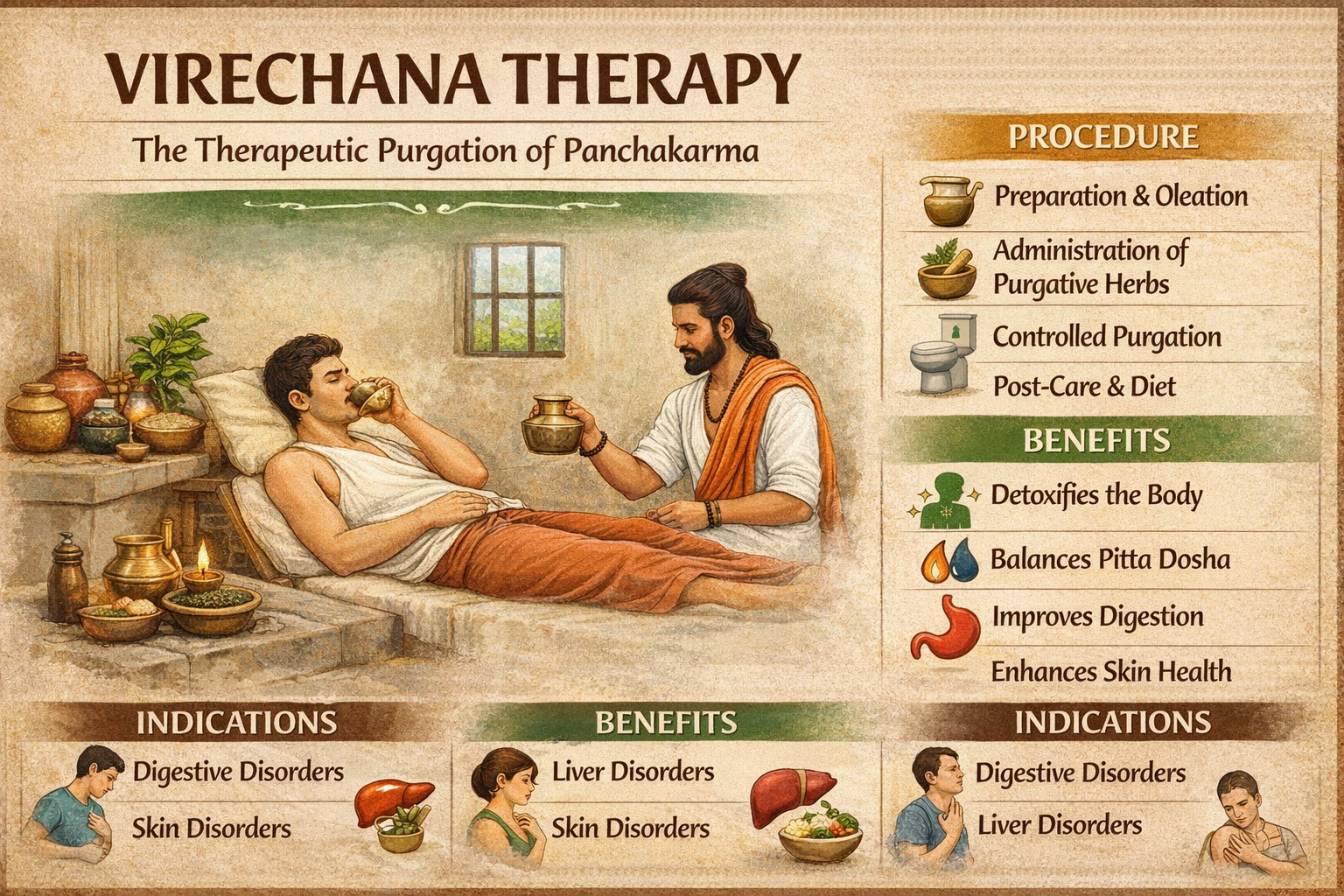
Detox Through Purgation: The Pitta Purification Procedure
Virechana therapy is the second of the five Panchakarma procedures and the primary treatment for Pitta dosha disorders. This therapeutic purgation systematically eliminates aggravated Pitta from the body, particularly from the small intestine, liver, and gallbladder. Unlike conventional laxatives, Virechana is a meticulously controlled procedure that removes toxins while preserving and enhancing digestive function.
HISTORICAL CONTEXT
Virechana is extensively described in the Charaka Samhita (Kalpa Sthana) and Sushruta Samhita (Chikitsa Sthana). It is considered the treatment of choice for Pitta-dominant disorders and is classified as a “Shodhana” (purification) therapy. The procedure is traditionally performed during the autumn season (Sharad Ritu), when Pitta naturally accumulates and is most easily eliminated.
THERAPEUTIC PRINCIPLES
MECHANISM OF ACTION
| Phase | Process | Therapeutic Effect |
| Poorva Karma | Deepana-Pachana, Snehapana | Mobilizes Pitta from deep tissues |
| Pradhana Karma | Administration of purgative herbs | Eliminates Pitta through lower tract |
| Paschat Karma | Dietary and lifestyle regimen | Restores Agni, prevents recurrence |
PHYSIOLOGICAL EFFECTS
- Stimulates peristalsis
- Enhances bile flow and secretion
- Reduces hepatic inflammation
- Clears small intestinal toxins
- Improves metabolic function
- Balances digestive enzymes
INDICATIONS
PRIMARY INDICATIONS
| Condition | Classical Name | Rationale |
| Hyperacidity | Amlapitta | Eliminates excess Pitta from stomach |
| Peptic ulcer | Parinama Shoola | Reduces gastric inflammation |
| Liver disorders | Yakrit Vikara | Improves hepatic function |
| Gallbladder disease | Pittashaya Vikara | Enhances bile flow |
| Jaundice | Kamala | Eliminates bilirubin overload |
| Skin disorders | Psoriasis, eczema, urticaria | Removes Pitta toxins |
| Inflammatory bowel | Grahani Roga | Reduces intestinal inflammation |
| Gout | Vatarakta | Eliminates uric acid and toxins |
SECONDARY INDICATIONS
- Chronic fever (Pitta type)
- Migraine (Pitta type)
- Allergic conditions
- Acne and pustular eruptions
- Premature graying
- Burning sensations anywhere in body
PSYCHOLOGICAL INDICATIONS
- Pitta-type anger and irritability
- Excessive ambition and competitiveness
- Perfectionism and rigidity
- Burnout from overwork
CONTRAINDICATIONS
| Category | Specific Conditions |
| Gastrointestinal | Severe ulcerative colitis, Crohn’s disease, intestinal obstruction, recent abdominal surgery |
| General | Severe debility, dehydration, electrolyte imbalance |
| Pregnancy/Lactation | Throughout pregnancy and breastfeeding |
| Age | Children under 7, elderly over 75 |
| Acute conditions | Acute diarrhea, acute dysentery, acute abdominal pain |
PROCEDURE DETAILS
POORVA KARMA (PREPARATORY PHASE) – 3-7 DAYS
| Step | Procedure | Purpose |
| Deepana-Pachana | Digestive herbs (Trikatu, Chitrakadi Vati) | Enhance digestive fire |
| Snehapana | Internal oleation with medicated ghee | Mobilize Pitta from tissues |
| Abhyanga | Full body oil massage | Loosen impurities |
| Swedana | Steam therapy | Dilute toxins, open channels |
Observation during Snehapana:
- Signs of proper oleation: Softening of skin, oiliness in stool, feeling of lightness
- Duration determined by physician based on patient response
PRADHANA KARMA (MAIN PROCEDURE)
Morning of Procedure:
- Patient awakens early (Brahma muhurta)
- Completes morning routines
- Final assessment by physician
Administration of Purgative Medicine:
- Medicated decoction or paste (typically Trivrit, Aragvadha, etc.)
- Dose calculated based on patient’s strength and condition
- Administered on empty stomach
Observation Phase:
| Time Period | Expected Events |
| 0-30 minutes | Medicine absorption begins |
| 30-120 minutes | First urge to defecate |
| 2-4 hours | Active purgation phase |
| 4-6 hours | Purgation subsides |
Vega (Purgation Episodes):
- Optimal: 10-20 vegas
- Number determined by physician based on condition
- Characteristics of stool observed for diagnosis
Signs of Proper Purgation:
- Stool becomes watery and clear at end
- Feeling of lightness in abdomen and body
- Clear sensation in chest and head
- Absence of excessive straining or distress
- Natural cessation without medication
PASCHAT KARMA (POST-PROCEDURE PHASE)
Immediate Post-Procedure (Day 1):
- Rest in warm room
- No sleep immediately after
- No food until appetite returns
- Light diet (khichadi) in evening
- Avoid cold water, wind exposure
Samsarjana Krama (Gradual Diet Regimen):
| Day | Diet | Duration |
| Day 1 | Liquid gruel (Peya) | Once or twice |
| Day 2 | Semi-liquid gruel (Vilepi) | Twice |
| Day 3-4 | Thick gruel with vegetables | Gradually increasing |
| Day 5-7 | Normal light diet | Full diet by day 7 |
EXPECTED OUTCOMES
IMMEDIATE EFFECTS (24-48 HOURS)
- Feeling of lightness in abdomen and body
- Clear mind and sharp senses
- Improved appetite
- Clearer skin
- Reduced burning sensations
SHORT-TERM BENEFITS (1-4 WEEKS)
- Significant improvement in digestive symptoms
- Reduction in acidity and heartburn
- Clearer complexion
- Improved liver function tests
- Better energy and vitality
LONG-TERM BENEFITS (3-6 MONTHS)
- Reduced recurrence of Pitta disorders
- Improved metabolic function
- Better stress tolerance
- Enhanced digestion
- Prevention of disease progression
COMPLICATIONS AND MANAGEMENT
| Complication | Cause | Management |
| Excessive purgation | Over-dose, sensitive patient | Oral rehydration, rice water, fennel-coriander tea |
| Incomplete purgation | Insufficient medicine, constipation | Enema, repeat procedure after assessment |
| Syncope | Weak patient, fluid loss | Rest, warm milk, cardiac stimulants if needed |
| Rectal irritation | Frequent episodes | Sitz bath, coconut oil application |
| Dehydration | Excessive fluid loss | Oral rehydration, electrolyte management |
QUALITY STANDARDS
FACILITY REQUIREMENTS
- Dedicated Panchakarma room
- Private restroom adjacent
- Warm, comfortable environment
- Emergency equipment
- Trained nursing staff for monitoring
PRACTITIONER REQUIREMENTS
- Qualified Ayurvedic physician
- Specialized Panchakarma training
- Experience in dosage calculation
- Emergency management capability
CONTEMPORARY RESEARCH
| Study Focus | Findings | Reference |
| Psoriasis management | 60-70% reduction in PASI scores | AYU, 2018 |
| Liver disorders | Improved LFT, reduced bilirubin | JAR, 2019 |
| Acne vulgaris | Significant lesion reduction | IJAM, 2020 |
| Irritable bowel syndrome | Symptom score improvement | AYUSHDHARA, 2021 |
CLINICAL SUMMARY
| Parameter | Details |
| Primary Indications | Pitta disorders, skin diseases, liver conditions |
| Ideal Season | Autumn (Sharad Ritu) |
| Preparation Duration | 3-7 days |
| Procedure Duration | 1 day (4-6 hours) |
| Recovery Duration | 7 days |
| Optimal Vega | 10-20 (physician determined) |
| Key Contraindications | Pregnancy, severe colitis, debility |
| Expected Outcome | Pitta elimination, digestive improvement |
CONCLUSION
Virechana therapy exemplifies Ayurveda’s precise approach to dosha-specific purification. By systematically eliminating aggravated Pitta through the lower tract, it provides profound relief for conditions ranging from hyperacidity to chronic skin disorders. The therapy’s emphasis on proper preparation, controlled administration, and systematic post-procedure care ensures maximum benefit with minimal risk.
As inflammatory and metabolic disorders continue to rise globally, Virechana therapy offers a time-tested approach to restoring balance at the deepest level.
