

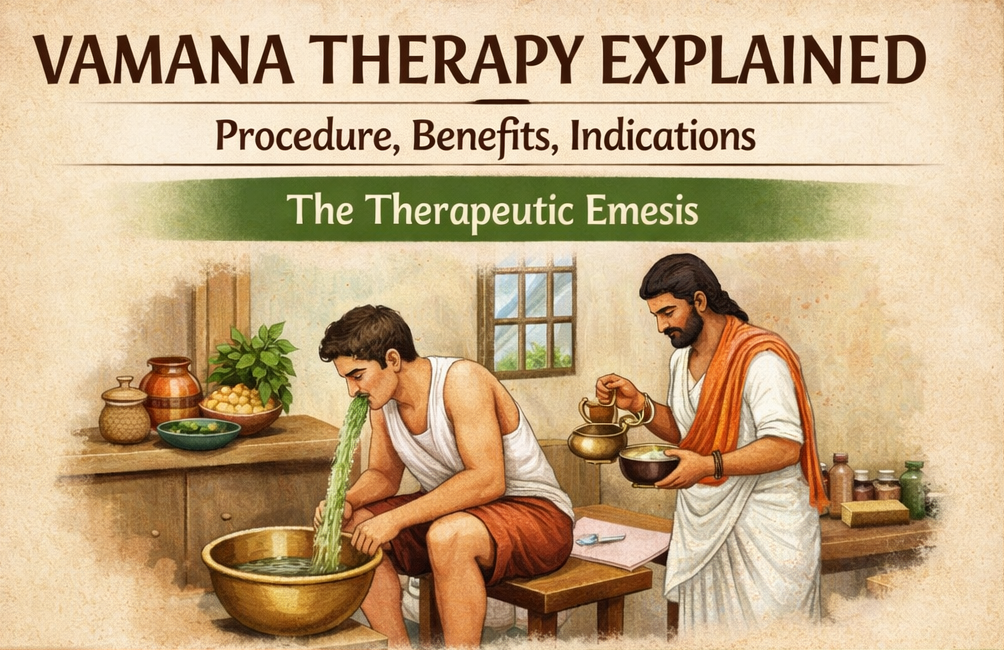
Procedure, Benefits, Indications: The Therapeutic Emesis
Vamana therapy stands as the first of the five Panchakarma procedures and one of the most powerful detoxification methods in Ayurveda. This therapeutic emesis is specifically designed to eliminate aggravated Kapha dosha from the body, particularly from the upper gastrointestinal tract and respiratory system. Far from being a simple induced vomiting, Vamana is a sophisticated, multi-stage procedure performed under strict classical guidelines to achieve profound therapeutic results.
HISTORICAL CONTEXT AND CLASSICAL SIGNIFICANCE
Vamana finds detailed description in all major Ayurvedic texts, particularly the Charaka Samhita (Sutra Sthana, Chapter 15) and Sushruta Samhita (Chikitsa Sthana, Chapter 33). It is considered the treatment of choice for Kapha-dominant disorders and is classified as a “Shodhana” (purification) therapy.
The procedure is traditionally performed during the spring season (Vasant Ritu), when Kapha naturally accumulates and liquefies, making it the optimal time for its elimination.
THERAPEUTIC PRINCIPLES
MECHANISM OF ACTION
| Phase | Process | Therapeutic Effect |
| Poorva Karma (Preparatory) | Internal and external oleation, sudation | Mobilizes toxins from deep tissues |
| Pradhana Karma (Main) | Controlled administration of emetic herbs | Expels Kapha and toxins from upper GI tract |
| Paschat Karma (Post) | Dietary and lifestyle regimen | Restores digestive fire, prevents recurrence |
PHYSIOLOGICAL EFFECTS
- Stimulates the vagus nerve
- Activates the parasympathetic nervous system
- Clears respiratory passages
- Reduces mucus secretion
- Enhances digestive enzyme activity
- Improves metabolic function
INDICATIONS
PRIMARY INDICATIONS
| Condition | Classical Name | Rationale |
| Bronchial asthma | Tamaka Shwasa | Removes Kapha from respiratory tract |
| Chronic bronchitis | Kapha Kasa | Clears bronchial mucus |
| Allergic rhinitis | Pratishyaya | Reduces nasal and sinus congestion |
| Sinusitis | Dushta Pratishyaya | Drains accumulated Kapha |
| Skin disorders | Psoriasis, eczema | Eliminates toxins underlying skin pathology |
| Obesity | Sthaulya | Reduces Kapha and Medas |
| Diabetes mellitus | Madhumeha | Improves pancreatic function |
| Edema | Shotha | Removes excess fluid |
PSYCHOLOGICAL INDICATIONS
- Kapha-type depression (lethargy, heaviness)
- Emotional congestion
- Excessive attachment and possessiveness
- Mental dullness and stagnation
CONTRAINDICATIONS
| Category | Specific Conditions |
| Cardiovascular | Severe hypertension, heart failure, recent MI |
| Gastrointestinal | Peptic ulcer, ulcerative colitis, hernia, recent abdominal surgery |
| Respiratory | Active tuberculosis, severe COPD, hemoptysis |
| Metabolic | Severe debility, extreme weakness, uncontrolled diabetes |
| Pregnancy/Lactation | Throughout pregnancy and breastfeeding |
| Age | Children under 7, elderly over 75 |
| Acute conditions | Acute fever, acute infections, acute pain |
PROCEDURE DETAILS
POORVA KARMA (PREPARATORY PHASE) – 3-7 DAYS
| Step | Procedure | Purpose |
| Deepana-Pachana | Digestive herbs | Enhance digestive fire, digest Ama |
| Snehapana | Internal oleation with medicated ghee | Mobilize toxins from deep tissues |
| Abhyanga | Full body oil massage | Loosen impurities, relax body |
| Swedana | Steam therapy | Liquefy Kapha, open channels |
PRADHANA KARMA (MAIN PROCEDURE)
Morning of Procedure:
- Patient awakens early, completes morning routines
- Light breakfast if indicated (usually avoided)
- Final assessment by physician
Administration of Emetic Medicine:
- Medicated decoction (typically Madanaphala, Yashtimadhu, etc.)
- Quantity determined by physician based on patient’s strength and condition
- Administered on empty stomach
Observation Phase:
- Patient monitored for signs of proper emesis
- Number of vomitings: typically 4-8 episodes
- Vega (expulsion): 4-6 vegas considered optimal
- Characteristics of expelled material observed for diagnosis
Signs of Proper Emesis:
- Bitter or foul taste at end of vomiting
- Feeling of lightness in chest and head
- Clear sensation in throat and nasal passages
- Absence of excessive strain or distress
PASCHAT KARMA (POST-PROCEDURE PHASE)
Immediate Post-Procedure (Day 1):
- Rest in warm room
- No sleep immediately after
- Light diet (khichadi) in evening
- Avoid cold water, wind exposure
Samsarjana Krama (Gradual Diet Regimen):
| Day | Diet | Duration |
| Day 1 | Liquid gruel (Peya) | Morning and evening |
| Day 2 | Semi-liquid gruel (Vilepi) | Morning and evening |
| Day 3-4 | Thick gruel with vegetables | Gradually increasing |
| Day 5-7 | Normal light diet | Full diet by day 7 |
Duration of Therapy:
- Preparatory phase: 3-7 days
- Main procedure: 1 day
- Post-procedure regimen: 7 days
- Total: Approximately 10-14 days
EXPECTED OUTCOMES
IMMEDIATE EFFECTS (24-48 HOURS)
- Feeling of lightness in chest and head
- Clear breathing
- Improved appetite
- Mental clarity
- Reduced lethargy
SHORT-TERM BENEFITS (1-4 WEEKS)
- Significant improvement in respiratory symptoms
- Better digestion
- Weight reduction
- Clearer skin
- Enhanced energy
LONG-TERM BENEFITS (3-6 MONTHS)
- Reduced frequency of recurrent infections
- Improved metabolic function
- Better stress tolerance
- Enhanced overall immunity
- Prevention of disease progression
COMPLICATIONS AND MANAGEMENT
| Complication | Cause | Management |
| Excessive vomiting | Over-administration, weak patient | Rest, rice water, fennel tea |
| Incomplete emesis | Insufficient medicine, obstruction | May require repeat procedure after assessment |
| Syncope | Weak patient, excessive strain | Rest, warm milk, cardiac stimulants if needed |
| Hematemesis | Pre-existing ulcer, excessive force | Emergency measures, physician intervention |
| Dehydration | Excessive fluid loss | Oral rehydration, rice water, coconut water |
QUALITY STANDARDS AND FACILITY REQUIREMENTS
FACILITY REQUIREMENTS
- Dedicated Panchakarma room with appropriate ventilation
- Easy access to restroom facilities
- Warm, comfortable environment
- Emergency medical equipment
- Trained nursing staff
PRACTITIONER REQUIREMENTS
- Qualified Ayurvedic physician (BAMS minimum)
- Specialized training in Panchakarma
- Experience in emergency management
- Ability to recognize complications early
CONTEMPORARY RESEARCH
| Study Focus | Findings | Reference |
| Asthma management | Significant improvement in FEV1, reduced attack frequency | Journal of Ayurveda, 2018 |
| Obesity treatment | 5-8% weight reduction, improved lipid profile | AYU, 2019 |
| Psoriasis | PASI score reduction, prolonged remission | IJAR, 2020 |
| Allergic rhinitis | Symptom score reduction, improved quality of life | AYUSHDHARA, 2021 |
CLINICAL SUMMARY
| Parameter | Details |
| Primary Indications | Kapha disorders, respiratory conditions, metabolic syndrome |
| Ideal Season | Spring (Vasant Ritu) |
| Preparation Duration | 3-7 days |
| Procedure Duration | 1 day (2-4 hours) |
| Recovery Duration | 7 days |
| Optimal Vega (Vomiting episodes) | 4-6 |
| Key Contraindications | Pregnancy, peptic ulcer, severe debility |
| Expected Outcome | Kapha elimination, respiratory relief, metabolic improvement |
CONCLUSION
Vamana therapy represents Ayurveda’s most sophisticated approach to managing Kapha-dominant disorders. When performed by qualified practitioners under proper conditions, it offers profound and lasting relief for conditions that often prove refractory to conventional treatment. The therapy’s comprehensive approach—addressing not just symptoms but the underlying doshic imbalance—exemplifies the holistic philosophy of Ayurveda.
As respiratory and metabolic disorders reach epidemic proportions globally, Vamana therapy’s relevance extends far beyond its traditional boundaries. For the Ayurvedic practitioner, it remains an indispensable tool. For the discerning patient, it offers hope for true healing rather than mere symptom management.
