

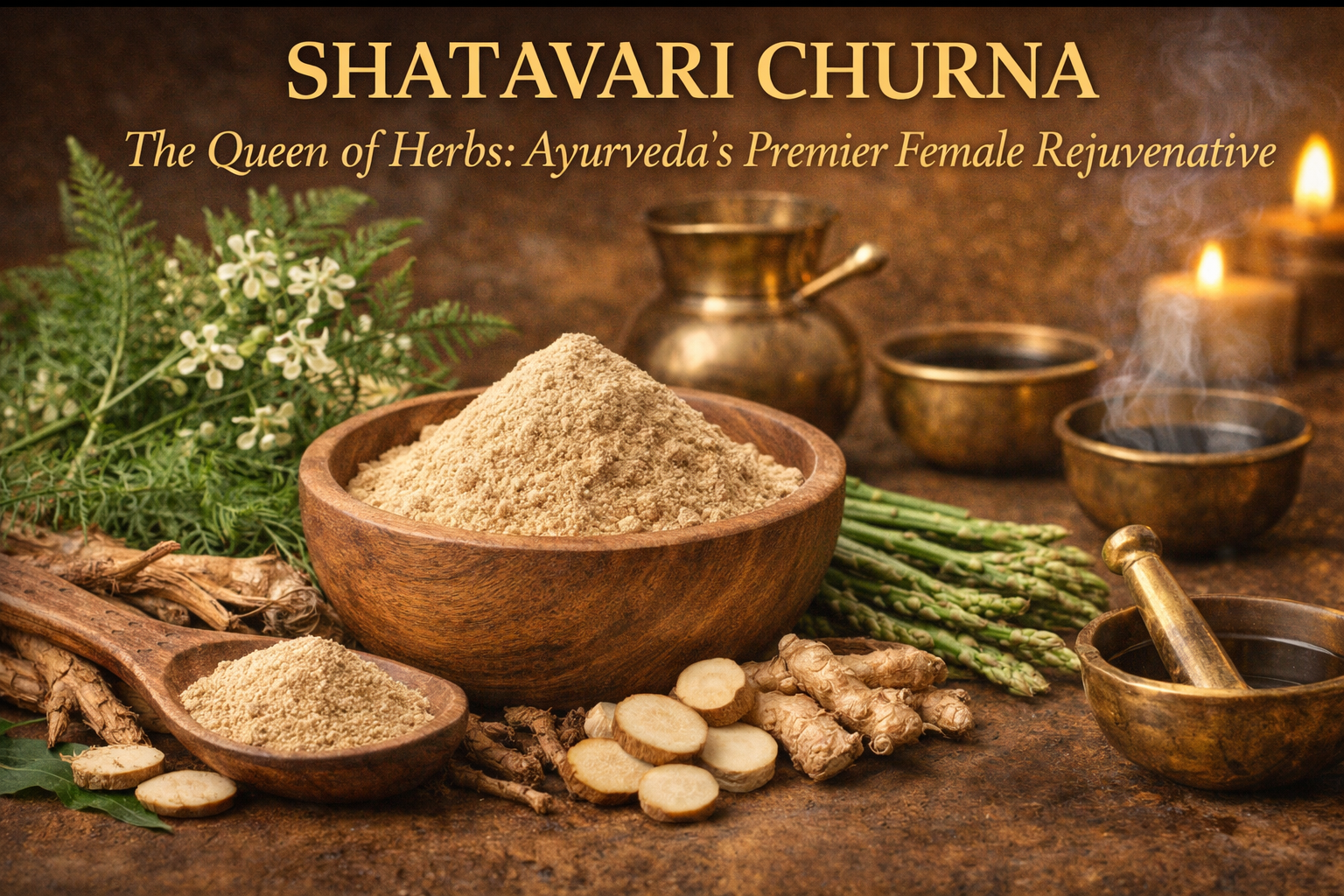
SHATAVARI CHURNA
The Queen of Herbs: Ayurveda’s Premier Female Rejuvenative
In the vast treasury of Ayurvedic herbs, few hold as exalted a position as Shatavari (Asparagus racemosus). Revered as the foremost female rejuvenative, this remarkable herb has supported women’s health through all stages of life for over two millennia. Its name itself tells a story—”Shatavari” literally translates to “she who possesses a hundred husbands,” an ancient metaphor for its profound ability to enhance fertility, vitality, and feminine essence.
As modern science begins to validate what Ayurvedic sages have known for centuries, Shatavari is emerging from the shadows of traditional medicine to claim its rightful place in the global wellness landscape. This comprehensive exploration delves into the botanical, clinical, and commercial dimensions of this extraordinary herb.
BOTANICAL PROFILE
| Scientific Name | Asparagus racemosus Willd. |
| Family | Asparagaceae (formerly Liliaceae) |
| Part Used | Tuberous roots |
| Energetics | Cooling (Shita Virya) |
| Taste | Sweet (Madhura), Bitter (Tikta) |
| Doshic Action | Balances Pitta and Vata |
THE CLASSICAL LEGACY
Shatavari occupies a place of prominence in Ayurveda’s foundational texts. The Charaka Samhita classifies it as a “Rasayana” (rejuvenative) and “Vayahsthapana” (age-defying) herb. It appears in multiple formulations throughout the classical literature, often as the primary ingredient in preparations designed for female health, lactation, and reproductive vitality.
The Bhavaprakasha Nighantu, a renowned materia medica, describes Shatavari as “Madhura, Snigdha, Guru, Shita” — sweet, unctuous, heavy, and cold in potency — properties that make it ideally suited for pacifying the hot, sharp qualities of Pitta dosha while nourishing the dry, light qualities of Vata.
In traditional practice, Shatavari is classified as:
- Vrishya (aphrodisiac) — enhancing reproductive tissue health
- Stanyajanana (galactogogue) — promoting healthy lactation
- Balya (strength promoter) — building physical stamina
- Sukrala (semen enhancing) — supporting reproductive fluids
- Rasayana (rejuvenative) — promoting longevity and tissue regeneration
PHYTOCHEMISTRY: THE SCIENCE BEHIND THE HERB
Modern analytical chemistry has identified over 50 compounds in Shatavari roots, with the primary active constituents being steroidal saponins known collectively as “shatavarins.”
| Compound Class | Key Constituents | Primary Activity |
| Steroidal Saponins | Shatavarin I-IX | Hormonal modulation, immunomodulation |
| Isoflavones | Racemosol, Racemofuran | Estrogenic activity, antioxidant |
| Alkaloids | Asparagamine A | Anti-oxytocic, uterine relaxant |
| Polysaccharides | Fructans, Glucomannans | Immunostimulant, prebiotic |
| Vitamins | B-complex, Vitamin C | Metabolic support |
| Minerals | Calcium, Zinc, Magnesium | Bone health, enzyme cofactors |
The synergistic action of these compounds—particularly the shatavarins—creates the herb’s unique ability to modulate rather than simply stimulate female physiology.
THERAPEUTIC APPLICATIONS
FEMALE REPRODUCTIVE HEALTH
Shatavari’s primary claim to fame lies in its profound affinity for the female reproductive system. Clinical observation and emerging research support its use across the female lifespan:
Menstrual Health
- Regulates menstrual cycle regularity
- Reduces dysmenorrhea (painful menstruation)
- Manages menorrhagia (heavy bleeding)
- Balances hormonal fluctuations
- Addresses PMS symptoms including irritability and bloating
Fertility Support
- Enhances follicular development
- Supports healthy ovulation
- Improves endometrial receptivity
- Nourishes reproductive tissues (Shukra Dhatu)
- Reduces stress-related fertility challenges
Polycystic Ovary Syndrome (PCOS)
While classical texts do not mention PCOS specifically, the herb’s hormonal balancing properties make it valuable in managing:
- Menstrual irregularity
- Insulin resistance (through bitter taste)
- Stress-related hormonal disruption
- Inflammatory components of the condition
LACTATION SUPPORT
Perhaps Shatavari’s most clinically validated application is as a galactogogue—an agent that promotes breast milk production.
Mechanisms of Action:
- Stimulates prolactin secretion
- Enhances mammary glandular tissue health
- Provides nutritional support for milk production
- Reduces stress that can inhibit let-down reflex
- Improves milk quality through nutritive properties
Clinical Evidence:
Multiple studies have demonstrated significant increases in breast milk volume in nursing mothers taking Shatavari compared to placebo. One randomized controlled trial showed a 50-80% increase in serum prolactin levels and corresponding increase in milk production.
MENOPAUSAL SUPPORT
As women transition through menopause, Shatavari offers cooling, nourishing support:
- Reduces hot flashes and night sweats
- Manages mood swings and emotional lability
- Supports bone mineral density
- Addresses vaginal dryness
- Promotes restful sleep
- Supports cardiovascular health
DIGESTIVE HEALTH
Beyond its reproductive applications, Shatavari is a valuable digestive remedy:
- Soothes gastric and duodenal ulcers
- Reduces hyperacidity and heartburn
- Supports mucosal integrity throughout the GI tract
- Acts as a mild demulcent laxative
- Helps manage inflammatory bowel conditions
- Serves as a prebiotic, supporting healthy gut flora
IMMUNE MODULATION
As a Rasayana, Shatavari strengthens host resistance:
- Enhances phagocytic activity of macrophages
- Increases antibody production
- Supports natural killer cell activity
- Provides antioxidant protection
- Reduces inflammation through cytokine modulation
ADAPTOGENIC PROPERTIES
Emerging research positions Shatavari as a valuable adaptogen:
- Reduces cortisol levels
- Improves stress resilience
- Supports adrenal function
- Enhances mental clarity under stress
- Reduces fatigue and exhaustion
CLINICAL APPLICATIONS BY LIFE STAGE
| Life Stage | Primary Applications | Supporting Benefits |
| Adolescence | Menstrual regulation, PMS management | Acne reduction, emotional balance |
| Reproductive Years | Fertility, cycle regulation, conception support | Stress management, digestive health |
| Pregnancy | Safe under supervision (first trimester caution) | Nutritional support, preparation for lactation |
| Postpartum | Lactation, recovery, rejuvenation | Postpartum depression support, energy restoration |
| Perimenopause | Hormonal transition, symptom management | Bone health, emotional balance |
| Menopause | Hot flashes, vaginal health, cardiovascular support | Healthy aging, cognitive function |
FORMULATIONS AND DOSAGE
TRADITIONAL PREPARATIONS
Shatavari is most commonly available in the following forms:
| Formulation | Description | Typical Dosage |
| Shatavari Churna | Fine powder of dried root | 3-6 grams twice daily |
| Shatavari Capsules | Standardized extract or powder in vegetarian capsules | 500-1000 mg twice daily |
| Shatavari Ghrita | Medicated ghee preparation | 1-2 teaspoons with warm milk |
| Shatavari Syrup | Liquid formulation | 10-20 ml twice daily |
| Shatavari Ksheerapaka | Milk decoction | 50-100 ml once or twice daily |
OPTIMAL ADMINISTRATION
Anupama (Adjuvants):
- Warm Milk: The classic adjuvant; enhances nourishing and rejuvenating properties
- Honey: For enhanced absorption and Kapha conditions
- Ghee: For Pitta disorders and deep tissue nourishment
- Warm Water: For general use and digestive applications
Best Time for Consumption:
- Morning with warm milk for daily rejuvenation
- Evening before bed for reproductive tissue nourishment
- With meals for digestive support
- 30 minutes before nursing for lactation support
Duration of Use:
Shatavari is safe for long-term use. For chronic conditions, cyclical use (3 months on, 1 week off) is often recommended under professional guidance.
SAFETY PROFILE AND CONTRAINDICATIONS
PRECAUTIONS
| Condition | Recommendation |
| Pregnancy | Avoid in first trimester; use under supervision thereafter |
| Estrogen-sensitive conditions | Use with caution; monitor professionally |
| Endometriosis | Professional supervision recommended |
| Uterine fibroids | Individual assessment required |
| Diabetes | Monitor blood sugar; may enhance hypoglycemic effect |
| Diuretic use | May increase diuretic effect |
DRUG INTERACTIONS
Shatavari may interact with:
- Hormonal therapies (birth control, HRT)
- Lithium (potential interaction)
- Diuretics
- Antihypertensive medications
- Antidiabetic drugs
ADVERSE EFFECTS
Generally well-tolerated, rare effects may include:
- Mild gastric discomfort (usually transient)
- Allergic reactions (rare, in sensitive individuals)
- Estrogenic effects at very high doses
QUALITY CONSIDERATIONS
The therapeutic efficacy of Shatavari depends critically on quality:
| Quality Parameter | Optimal Characteristic |
| Source | Wild-crafted or organically cultivated |
| Root age | Mature roots (2-3 years growth) |
| Processing | Sun-dried, properly stored |
| Saponin content | Standardized to Shatavarin content |
| Microbial purity | GMP certified, pathogen-free |
| Heavy metals | Tested and within safe limits |
MARKET ANALYSIS AND COMMERCIAL SIGNIFICANCE
GLOBAL MARKET POSITION
Shatavari has emerged as a significant player in the global herbal supplement market, with particularly strong demand in:
| Region | Market Characteristics | Growth Drivers |
| India | Traditional staple, mass market | Household remedy, practitioner prescriptions |
| United States | Premium supplement, specialty retail | Women’s health focus, natural hormone balance |
| United Kingdom | Health food stores, online retail | Natural menopause support |
| Europe (Germany, France) | Integrative medicine, pharmacy | Evidence-based natural medicine |
| Australia | Wellness channel, naturopathy | Fertility support, women’s wellness |
| Middle East | Growing market, traditional affinity | Female health, lactation support |
MARKET SEGMENTATION
By Product Type:
- Traditional Churna (bulk powder)
- Capsules and Tablets (convenience format)
- Liquid Extracts and Tinctures (concentrated)
- Medicated Ghee (Shatavari Ghrita)
- Combination Formulations (with other herbs)
- Functional Foods and Beverages
By Distribution Channel:
- Ayurvedic pharmacies and clinics
- Modern retail (pharmacies, health stores)
- E-commerce (Amazon, specialty sites)
- Direct-to-consumer (brand websites)
- Practitioner channels
- Export/wholesale
By Consumer Segment:
- Nursing mothers (primary segment)
- Menopausal women (fastest growing)
- Fertility-seeking women
- General wellness consumers
- Ayurvedic practitioners’ patients
- International wellness tourists
MARKET TRENDS AND DRIVERS
- Rising Women’s Health Awareness
Increased consumer education about natural approaches to hormonal health - Preference for Natural Alternatives
Shift away from synthetic hormones toward botanical support - Fertility Focus
Growing demand for natural fertility support, delayed childbearing - Menopause Management
Aging demographic seeking natural symptom relief - Clean Label Movement
Demand for single-ingredient, transparently sourced products - Scientific Validation
Growing body of research supporting traditional uses - Postpartum Wellness
Increased focus on maternal health and breastfeeding support
COMPETITIVE LANDSCAPE
The Shatavari market features a mix of traditional Ayurvedic manufacturers and modern nutraceutical companies:
Traditional Leaders:
- Dabur
- Baidyanath
- Zandu
- Himalaya
- Patanjali
Modern Players:
- Organic India
- Himalaya (global range)
- Banyan Botanicals
- Nature’s Way
- Gaia Herbs
- Planetary Herbals
Differentiation Strategies:
- Organic certification
- Standardized extract claims
- Sustainable sourcing
- Fair trade practices
- Combination formulations
- Clinical research support
MARKET CHALLENGES
- Quality Consistency
Variation in saponin content between batches and sources - Adulteration Risk
Substitution with other Asparagus species - Regulatory Complexity
Varying status (food supplement vs. traditional medicine) across markets - Consumer Education
Need for awareness about proper use and indications - Supply Chain Issues
Sustainable wild collection vs. cultivation balance
SUSTAINABILITY AND ETHICAL SOURCING
The growing global demand for Shatavari raises important questions about sustainable supply:
CONSERVATION STATUS
While not currently endangered, wild populations face pressure from:
- Over-harvesting of mature roots
- Habitat loss
- Climate change impacts
- Collection before seed dispersal
SUSTAINABLE SOLUTIONS
Cultivation Initiatives:
- Promoting commercial farming to reduce wild collection
- Developing high-yielding varieties
- Supporting farmer cooperatives
- Implementing fair trade practices
Harvesting Guidelines:
- Collection only from mature plants (3+ years)
- Leaving portion of root for regeneration
- Seed collection and replanting
- Rotational harvesting areas
Certification Programs:
- Organic certification
- FairWild certification
- Fair Trade certification
- Company-specific sustainability programs
FUTURE DIRECTIONS
RESEARCH PRIORITIES
- Mechanistic Studies
Detailed understanding of Shatavarin interactions with hormone receptors - Clinical Trials
Larger, well-designed trials for specific indications (menopause, PCOS) - Safety Studies
Long-term safety data, particularly in hormone-sensitive conditions - Pharmacokinetics
Absorption, distribution, metabolism, and excretion studies - Synergy Research
Interactions with other herbs in combination formulations
PRODUCT INNOVATION
- Novel Delivery Systems
Liposomal formulations, nano-emulsions for enhanced bioavailability - Functional Foods
Shatavari-enriched products (granola, protein bars, beverages) - Personalized Medicine
Dosage and formulation tailored to individual constitution (Prakriti) - Combination Products
Evidence-based synergistic blends for specific indications - Phytopharmaceutical Development
Purified Shatavarin extracts for targeted therapeutic applications
MARKET EXPANSION
- Geographic Growth
Emerging markets in Latin America, Africa, Southeast Asia - New Consumer Segments
Male health (adaptogenic applications), pediatric nutrition - Integrative Medicine Integration
Incorporation into hospital protocols, insurance coverage - Professional Education
Training healthcare providers in appropriate use
CONCLUSION
Shatavari Churna stands as a testament to the profound wisdom of Ayurveda—an herb that has supported women through the ages, now validated by modern science and embraced by a global audience. Its remarkable range of applications, from lactation support to menopausal comfort, from fertility enhancement to digestive health, makes it one of the most valuable botanicals in the Ayurvedic pharmacopoeia.
As the world increasingly recognizes the importance of natural, holistic approaches to health, Shatavari’s significance will only grow. For the Ayurvedic industry, it represents both a responsibility—to ensure sustainable, ethical sourcing—and an opportunity—to share this gift of nature with women everywhere.
In an age of synthetic hormones and quick fixes, Shatavari reminds us of a deeper truth: that true health comes from nourishment, balance, and alignment with nature’s wisdom. The Queen of Herbs has ruled for millennia, and her reign shows no sign of ending.
